Saturday, January 18, 2020

PAHA Awards and Awardees for 2019 Presented at the Kosciuszko Foundation in New York, 1/4/2020

PAHA Awardees with the Board of Directors 

During a well-attended Awards Ceremony held at the elegant ballroom of the Kosciuszko Foundation in New York, on Saturday, January 4, 2020, the following Awards were presented by PAHA's President Dr. Anna Muller and PAHA's Vice President, Dr. Marta Cieslak, assisted by Dr. Pien Versteegh, PAHA's Executive Director.


Marek Skulimowski, the KF President/Executive Director

The ceremony started from a welcome by Marek Skulimowski, President and Executive Director of the Kosciuszko Foundation, expressing delight about this renewed collaboration and hope for a variety of joint projects between PAHA and the KF in the future. Prof. Neal Pease, First Vice President of PAHA, discussed a history of the collaboration between PAHA and the Kosciuszko Foundation, and Prof. Anna Muller presented PAHA's achievements in the past year, and the role of PAHA Awards and Awardees in Polish and Polish American culture.


OSKAR HALECKI PRIZE FOR GRAZYNA KOZACZKA

Oskar Halecki Prize recognizes an important book or monograph on the Polish experience in the United States. The award was presented to Grażyna J. Kozaczka, Writing the Polish American Woman in Postwar Ethnic Fiction (Ohio University Press, 2019)


Kozaczka's book investigates the construction of Polish American womanhood in the fiction by Polish American authors of the second half of the 20th and early 21th centuries. It demonstrates how Polish American women writers have responded to the gender expectations of their communities, societies, and nations and how their heroines sought empowerment. One of the reviews calls it a unique scholarly work that "positions ethnic gender construction and performance at an intersection of social class, race, and sex."


Prof. Kozaczka with her Award

SWASTEK PRIZE FOR STEPHEN M. LEAHY

The Swastek Prize is awarded annually for the best article published during the previous year in a given volume of Polish American Studies, the journal of the Polish American Historical Association. This award, established in 1981, is named in honor of Rev. Joseph V. Swastek (1913-1977), the editor of the Polish American Studies for many years, and a past president of PAHA. It was presented to Stephen M. Leahy for his article “George Wallace and the Myth of the White Ethnic Backlash in Milwaukee, 1958-1964” (PAS 75, no. 2, Autumn 2018)


While the PAS Editorial Board members valued all of the contributions to volume 75, Stephen M. Leahy’s article “George Wallace and the Myth of the White Ethnic Backlash in Milwaukee, 1958-1964” (PAS 75, no. 2, Autumn 2018) has been selected for the Swastek Award for the best article in the 2018 volume of Polish American Studies. Leahy's article is a timely and careful analysis of the heated political atmosphere during the Civil Rights era. Leahy effectively questions the sweeping thesis that working-class Polish Americans were particularly receptive to Wallace's racist message in Milwaukee, WI. Leahy’s article is a fine example of meticulous research, which challenges a long-established opinion by cross-checking and triangulating a variety of sources. It offers a compelling political microhistory and it should have an impact on the historiography of race relations in twentieth-century America.


SKALNY CIVIC ACHIEVEMENT AWARDS

Skalny Civic Achievement Awards honor individuals or groups who advance PAHA's goals of promoting research and awareness of the Polish American experience and/or have made significant contributions to Polish or Polish American community and culture.


TEOFIL LACHOWICZ is a historian, archivist, journalist, and teacher with a long list of projects that all contribute to the popularization and preservation of Polish and Polish American experience in the US. Mr. Lachowicz is a historian and history teacher but his work includes also a wide variety of activities in the Polonia community. He has been an archivist at the Polish Army Veterans Association in America since 1998 and is also editor of the monthly "Weteran." He is an author of several works on military Polish American history and has also contributed to Polish American newspapers.

Dr. JOHN GUZLOWSKI, a former PAHA Board Member and Awardee, has published in a wide range of genres: poetry, prose, literary criticism, reviews, fiction and nonfiction. Born in a refugee camp in Germany after World War II, Guzlowski came to America with his family as a Displaced Person in 1951. His parents were Polish slave laborers in Nazi Germany during the war. In much of his work, Guzlowski remembers and honors the experiences and ultimate strength of these survivors. His critically acclaimed 2016 volume of poetry Echoes of Tattered Tongues is as beautiful as it is harrowing. He has also been able to weave the Polish American experience in his 2018 novel Suitcase Charlie. In his very frequent public speaking engagements with audiences of all sorts (academic, non-academic, all ages), he is promoting the experience of Polish immigrants in the post-WWII years and the generations that followed.


Geoffrey Gyrisco and Michael Retka.

SPENCER HOWE, STANISLAW POSZWA, GEOFFREY GYRISCO and MICHAEL RETKA are a team of scholars and activists spanning MN and WI who conduct research and community engagement efforts regarding the work of early 20th century Polish-American architect VICTOR CORDELLA, active in Minnesota. Fr. Spencer Howe and Fr. Stanislaw Poszwa represent the Holy Cross Church in Minneapolis, MN. Dr. Geoffrey Gyrisco is a resident of Madison, WI and Michael Retka resides in Little Falls, MN.   Over the past two years they have come together to document Cordella’s extensive body of architectural design in Minnesota and Wisconsin and assess his lasting impact and influence on two dozen mostly Polish Roman and Eastern Rite Catholic communities. Cordella was a graduate of the Jan Matejko Academy of Fine Arts who immigrated to the US in 1893 and was in active architectural practice between the 1890s and mid-1930s. The list of the team’s achievements includes preservation, popularization, and academic efforts that highlight, investigates, and brings to the general and academic audiences Cordella’s legacy.


Norman Kelker accepts his award

AMICUS POLONIAE AWARD FOR DR. NORMAN KELKER AND JOANN FALLETTA

The Amicus Poloniae Award recognizes significant contributions enhancing knowledge of Polish and Polish-American heritage by individuals not belonging to the Polish-American community.

Dr. NORMAN E. KELKER has had a long career as a microbiologist. For many years now Dr. Kelker has been an active member of the Polish Institute of Arts and Sciences of America and a supporter of the Kosciuszko foundation. His interests in history and family history resulted in his many presentations. Most recently, Dr. Kelker presented his research on Ernestine Rose, a Polish Born Leader of the American Suffrage Movement and Herbert Hoover’s support for Poland. Dr. Kelker is a long-time friend of Poland and Polonia.


Dr. Kelker with his Award

 The second Amicus Poloniae Awardee was JOANN FALLETTA.  Ms. JoAnn Falletta, Music Director of the Buffalo Philharmonic Orchestra received the award for continuous support of Polish and Polish American composers and musicians. Falletta has led numerous projects and events that showcased Polish and Polish American composers as well as invited Polish musicians to play with the Buffalo Philharmonic Orchestra. 


PULA DISTINGUISHED SERVICE AWARD FOR DR. IWONA KORGA

James Pula Distinguished Service Award is given to a member of PAHA who has rendered valuable and sustained service to the organization.

Dr.  Iwona Korga, Executive Director of the Pilsudski Institute was nominated by several individuals and an excerpt from one nomination reads as follows: "For years she has been promoting Polish history and culture though both research and public programming as Executive Director of the Piłsudski Institute and more recently as a member of the Board of Directors of the Polish & Slavic Federal Credit Union."  Dr Ewa Hoffman Jędruch, who is a Board Member of the Pilsudski Institute received the award on behalf of Dr. Korga.


Dr. Hoffman Jedruch with Dr. Korga's Award.


ZURAWSKI PRIZE FOR BEST BOOK OR ARTICLE ON POLISH AMERICANS ON SCREEN

Joseph W. Zurawski Prize is awarded for the best article or book published on the topic of Polish American screen images in films or television presented to audiences in the United States and released by American companies.

Sonia Caputa for "Stereotypes of Polish American Women in American TV Series" from volume Histories of Laughter and Laughter in History, (ed. by Rafał Borysławski, Justyna Jajszczok, Jakub Wolff, Alicja Bemben), Cambridge Scholars Publishing, 2016.


Dr. Puchalski with his Grant Certificate

YOUNG SCHOLAR TRAVEL GRANTS FOR  AVRAMCHUK and  PUCHALSKI

The Young Scholar Travel Grant ($500) supports a graduate student's/young scholar's participation in the PAHA upcoming annual conference.

 OLEKSANDR AVRAMCHUK is a Ph.D. student at the University of Warsaw. He is currently writing a doctoral dissertation on the vision of Ukraine in Polish émigré historical thought in the United States during the Cold War. The scope of his academic interests ranges from Polish-Ukrainian relations to modern nation-building processes in Central and Eastern Europe. He is an author of several scholarly articles and essays on Polish, Ukrainian and Russian historical thought in the 20 th century, as well as the American attitudes toward Eastern Europe.


Dr. Puchalski and Mr. Avramchuk with their Grant Certificates.

DR. PIOTR PUCHALSKI of the University of Wisconsin-Madison at the time of award. Dr. Piotr Puchalski was born in Warsaw, Poland and moved to New York City at the age of thirteen. He attended high school in Brooklyn and earned Bachelor’s degrees in European Studies and French from New York University. When Piotr applied for this award, he was still a Ph.D. candidate in modern European history at the University of Wisconsin-Madison. Since then, not only did he defend his doctoral dissertation but also accepted the position of assistant professor of history at the Institute of History and Archival Studies of the Pedagogical University of Cracow, where he currently lives.

The Awards Committee has decided not to award the Creative Arts Prize and the Haiman Award this year.


Attendees before the ceremony

Dr. Pien Versteegh

Dr. Neal Pease
Dr. Anna Muller and Dr. Marta Cieslak Present the Awards

 Geoffrey Gyrisco and Michael Retka 


Dr. Maja Trochimczyk 


Thursday, November 7, 2019

Program of PAHA's 77th Annual Meeting in New York, January 3-6, 2020

Painting by Julian Stanczak

PAHA’s 77th annual meeting will be held in New York as part of the 134th meeting of the American Historical Association on January 3–5, 2020 (Friday to Sunday).

https://aha.confex.com/aha/2020/webprogram/Symposium2620.html

PAHA Chair of the Program Committee: Anna Muller, Ph.D.; anmuller@umich.edu, University of Michigan-Dearborn
Painting by Julian Stanczak

2020 Annual Meeting Program 
77th Annual Meeting of Polish American Historical Association

Friday, January 3, 2020: 1:30 PM-3:00 PM Harlem Room (New York Hilton, Fourth Floor)
SESSION 1: BOOK PANEL: AMERICAN WARSAW: THE RISE, FALL, AND REBIRTH OF POLISH CHICAGO BY DOMINIC A. PACYGA
Chair: Neal Pease, University of Wisconsin–Milwaukee

Panel:
⨀ Ewa Barczyk, University of Wisconsin–Milwaukee;
⨀ David A. Gerber, State University of New York at Buffalo;
⨀ James Pula, Purdue University Northwest

_______________________________________________________________________

Friday, January 3, 2020: 3:30 PM-6:30 .
Midtown Room (New York Hilton, Fourth Floor)
PAHA BOARD MEETING. Chair: Anna Müller, President
_______________________________________________________________________

Saturday, January 4, 2020: 8:30 AM-10:00 AM
Hudson Room (New York Hilton, Fourth Floor)

SESSION 2: SEARCHING FOR A VOICE, SEARCHING FOR A PLACE
Chair: Marta Cieślak, University of Arkansas at Little Rock

Papers:
⨀ The Polish Rifle: Connie Wisniewski and the All-American Girls Professional Baseball League - Neal Pease, University of Wisconsin–Milwaukee;

⨀ Helena Modjeska’s Bilingual Morality Tale of 1896 - Maja Trochimczyk, Moonrise Press;

⨀ "There Are No Capitalists among Our Kind”: State, Nation, and Class in Dymytry Vyslotsky’s Interwar Lemkovyna - Nicolas K. Kupensky, Bowdoin College;

⨀ Stanisław Gutowski: America’s Secret Weapon in World War I - James Pula, Purdue University Northwest

Comment: Marta Cieślak, University of Arkansas at Little Rock

______________________________________________________________________

Saturday, January 4, 2020: 10:30 AM-12:00 PM
Hudson Room (New York Hilton, Fourth Floor)

SESSION 3: GRASSROOTS DEMOCRACY
Chair: Piotr Puchalski, Assistant Professor, Pedagogical University, Kraków

Papers:

⨀ The Polish Democratic Society and the Enthusiasts: Conflict and Cooperation in 1840s Poznań - Natalie Cornett, Brandeis University;

⨀ Education in Exile: The Committee for the Education of Poles in Great Britain, 1947–54: The Importance of Education as the Route to Civic Integration - Agata Błaszczyk, Polish University Abroad (PUNO);

⨀ An Immigrant Voice in Canada: Czas Polish Press Ltd - Magda Blackmore, University of Manitoba;

⨀ Zygmunt Haupta's Broadcasting Work at "Voice of America," 1951–60 - Barbara Krupa, Stanford University. Comment: Piotr Puchalski, Pedagogical University, Kraków

______________________________________________________________________

Saturday, January 4, 2020: 10:30 AM-12:00 PM
Midtown Room (New York Hilton, Fourth Floor)

SESSION 4: NEW AND OLD HOME: MOBILITY AND IDENTITY
Chair: Wiktor Marzec, R. Zajonc Institute for Social Studies, UW

Papers:

⨀ Looking at Both Sides of the Pond: Kashubian Fishermen Families from the Hel Peninsula, Poland and Jones Island, Milwaukee, Wisconsin - Anne Gurnack, University of Wisconsin–Parkside;

⨀ Mobility Patterns of Polish Migrants in the US, 1900–40: A Comparison between Pennsylvania and Illinois - Pien Versteegh, Maastricht University;

⨀ Going Home? Poles’ Return Migrations from Chicago to Poland - Hubert Izienicki, Purdue University Northwest;

⨀ Explaining Serfdom: Post-1945 Historians on Eastern Europe - Anna Sosnowska, University of Warsaw

⨀ Comment: Wiktor Marzec, Robert Zajonc Institute for Social Studies, University of Warsaw

_________________________________________________________________

Saturday, January 4, 2020: 1:30 PM-3:00 PM
Hudson Room (New York Hilton, Fourth Floor)

SESSION 5: POWER AND DISEMPOWERMENT IN THE LIVES OF POLISH AMERICAN WOMEN
Chair: Anna Sosnowska, University of Warsaw

Papers:

⨀ The Dangerous Intersection of Ethnicity and Sexuality in Migrant Fiction - Grażyna Kozaczka, Cazenovia College;

⨀ Between Assimilation and Resistance: The Transatlantic Modernity of Polish Rural Women - Marta Cieślak, University of Arkansas at Little Rock;

⨀ Mining “The Twenty” via Memory Work: Reinterpreting Story, Rewriting Identity - Kristina Kwacz, Empire State College, State University of New York.

⨀ Comment: Anna Sosnowska, University of Warsaw
__________________________________________________________________

Saturday, January 4, 2020: 1:30 PM-3:00 PM
Midtown Room (New York Hilton, Fourth Floor)

SESSION 6: IS THERE A HISTORY OF POLAND BEYOND THE HOLOCAUST?
Chair: John Bukowczyk, Wayne State University

Panel:

⨀ Natalia Aleksiun, Touro College, Graduate School of Jewish Studies ;
⨀ Anna Müller, University of Michigan–Dearborn;
⨀ Wiktor Marzec, Robert Zajonc Institute for Social Studies, University of Warsaw;
⨀ Janine P. Holc, Loyola University Maryland
__________________________________________________________________

Saturday, January 4, 2020: 3:30 PM-5:00 PM
Hudson Room (New York Hilton, Fourth Floor)

SESSION 7: HAMTRAMCK
Chair: Anna Müller, University of Michigan–Dearborn

Papers:

⨀ Interconnections and Parallels between Muslims and Polish Catholics in Hamtramck - Alisa Perkins, Western Michigan University;

⨀ Moving Out, Moving Back, Moving Over: 21st-Century Polonia in Hamtramck - Karen Majewski, University of Michigan;

⨀ Hamtramck, Poletown, and Bangladesh Avenue: Exploring the Intersection of Communal Autonomies in the Formation of Diaspora Identities - Sunanda Summadar, Wayne County Community College

Comment: Anna Müller, University of Michigan–Dearborn

__________________________________________________________________

Sunday, January 5, 2020: 8:30 AM-10:00 AM
Hudson Room (New York Hilton, Fourth Floor)

SESSION 8: POLISH RESPONSES TO GLOBAL MODERNITY
Chair: Neal Pease, University of Wisconsin–Milwaukee

Papers:

⨀ Poland’s Colonial Aspirations as a Diplomatic Instrument, 1932–39 - Piotr Puchalski, Pedagogical University, Kraków;

⨀ From Revolution to Nation: Popular Unrest in Russian Poland, 1907–18 - Wiktor Marzec, Robert Zajonc Institute for Social Studies, University of Warsaw;

⨀ Reconsidering the Christian View of the Jews in the Reality of the Holocaust - Rachel Brenner, University of Wisconsin–Madison;

⨀ A Patriot, a Soldier, a Confederate: The Life of Gaspard Tochman, 1799–1880 - Piotr Derengowski, University of Gdańsk

Comment: Neal Pease, University of Wisconsin–Milwaukee

_____________________________________________________________________

Sunday, January 5, 2020: 10:30 AM-12:00 PM
Hudson Room (New York Hilton, Fourth Floor)

SESSION 9: (POPULAR) CULTURE AS A POWERHOUSE OF IDENTITY BUILDING
Chair: Nicolas K. Kupensky, Bowdoin College

Papers:

⨀ Martha, Anna, and Pierogi: Mainstreaming Polish Identity through Polish Food - Anna D. Jaroszyńska-Kirchmann, Eastern Connecticut State University; With Illustrations by Zygmunt Iwanowski:

⨀ Recovering a Polish American Artist of America’s Golden Age of Illustration - Jill Noel Walker Gonzalez, La Sierra University;

⨀ Polish Emigrant Composer Karol Rathaus and His Work in Europe and in the USA - Mateusz Strzelecki, Academy of Music in Łódź

Comment: Nicolas K. Kupensky, Bowdoin College

_____________________________________________________________________

Sunday, January 5, 2020: 1:30 PM-3:00 PM

Hudson Room (New York Hilton, Fourth Floor)

SESSION 10: POLAND/POLONIA: GREENPOINT AND BEYOND. Chair: Pien Versteegh, Maastricht University

Papers:

⨀ Relational and Material Aspects of Transnational Home Making by Migrants from Poland to the US: A Cross-Generational Context - Karolina Nikielska-Sekula, University of South-Eastern Norway;

⨀ Seeing Greenpoint Change - Judith DeSena, St. John’s University;

⨀ Teaching How Krakow Changed, Visually - Jerome Krase, Brooklyn College, City University of New York.

Comment: Pien Versteegh, Maastricht University

_________________________________________________________________

Sunday, January 5, 2020: 3:30 PM-5:00 PM
Hudson Room (New York Hilton, Fourth Floor)

SESSION 11: IN THE SHADOW OF YALTA: POLISH ÉMIGRÉS AND THE SHAPING OF THE “INTELLECTUAL COLD WAR,” 1945–89
Chair: Anna D. Jaroszyńska-Kirchmann, Eastern Connecticut State University

Papers:

⨀ Polish Cold War Émigrés as a Part of Institutionalized American Sovietology: The State of Research - Sławomir Łukasiewicz, John Paul II Catholic University of Lublin and IPN;

⨀ Émigré “Scholarly Offensive”: Polish Historians, Ukrainian Studies, and the Making of the “Intellectual Cold War” - Oleksandr Avramchuk, University of Warsaw;

⨀ My Stormy Life Has Shaped It for Me: Jan Sawka—His Life and Work as a Record of Perturbations of History - Anna Rudek-Śmiechowska, Polish Institute of World Art Studies.

Comment: Jonathan W. Daly, U. of Illinois at Chicago

Painting by Julian Stanczak

Tuesday, October 1, 2019

Little Elephant - by Donna Urbikas. A Story from "Object that Speak" Project


This little elephant traveled with me from England where I was born to America in the early 1950's and has remained with me ever since as a reminder of the ordeals that my parents and sister endured during World War II.  Its origin began in the early 1940's in the Middle East where my father had been stationed with the newly formed Polish Army under General Władysław Anders.  In England, my mother sewed it by hand from my father's woolen army coat that the British had supplied to the newly forming Polish army.
After getting out of the USSR--the labor camp, the tortuous back and forth journey across the southern USSR, my mother and sister found temporary refuge in Tehran.  They had met my Polish Army officer father during that whole turmoil, first at the Polish Army camp in Tatishchevo in 1941, then in Dzhalal-Abad, and eventually in England.
My mother, Janina Ślarzyńska Zimmerman Solecka, and my sister, Mira Zimmerman, spent the remainder of the war in India so elephants were a daily presence in their lives.  In 1947, they left India for England as going back to Poland was not a good option for them.  Life in England was difficult for Poles like us with few material resources, but my mother was very resourceful and a talented seamstress, so she took my father's old army wool coat and a toy elephant pattern published in the local newspaper and made this toy elephant for me.  My father mounted it on a wooden platform with wooden wheels that he had made and tied a straw basket to the top, which he filled with colorful M&M candy.  I remember strolling with the elephant pulling it along and sneaking candy when I visited my mother in the hospital where she was recovering from pneumonia, shortly before we came to America.  The elephant was packed up for me but without the wheels.  
I didn't really like it at first since the material was very course so the elephant was mostly on display in my bedroom, but it survived all these years and it has been on display in my home ever since.  It reminds me of my mother and her frugality and all the sacrifices she made for me after surviving such a brutal journey and having been forced to leave her home in Poland, which today is Belarus.

Wednesday, August 14, 2019

A Story from our Website - A Portrait of Marszalek by Barbara Rylko Bauer


PAHA Website includes a fascinating project, curated by Dr. Anna Muller, PAHA President. The site, entitled, "Object that speak..." recounts first-hand stories of immigration experience of Polish Americans as told through objects that have acquired deep significance for their owners - symbolizing lost home, or new  hope for life in America. 
Anna Muller writes: "In the collection of objects included on this site, PAHA hopes to engage with the history of Polish Americans, but also to reflect on the phenomenology of objects. The objects tell the stories of people who traveled across the Atlantic. Most of the objects were to help them fulfill their dreams of remaking their lives anew far away from home. While they symbolize the importance of the home left behind, they also testify to the Polish immigrants’/people’s efforts to imbue a new home with significance. One of the first stories that grabbed our hearts – the story that is included on the website – was the story of a photo from a grandfather’s passport – a terrific example of how some objects, with time, take on a separate life from the one that served their creation; and how many of them now play a role in the lives of future generations. The relationship between us and objects is fluid – they affect our lives, but we also change their purpose. The passport was a tool that helped the grandfather’s transition, but with time, for the younger generations, it became the symbol of that transition, and also a link to the past. Photos of objects send a message of the power of human agency, but also of an individual’s daily life – daily gestures of care that nourish the connection with the past for the future."
We selected a story about Marshall Pilsudski to coincide with the anniversary of the Miracle on the Vistula, the famous battle defending Warsaw from the invading Soviet troops. Polish soldiers won the battle in August 1920 and preserved the independence of the newly restored country that was, partly, under Russian control since 1795 to 1918.
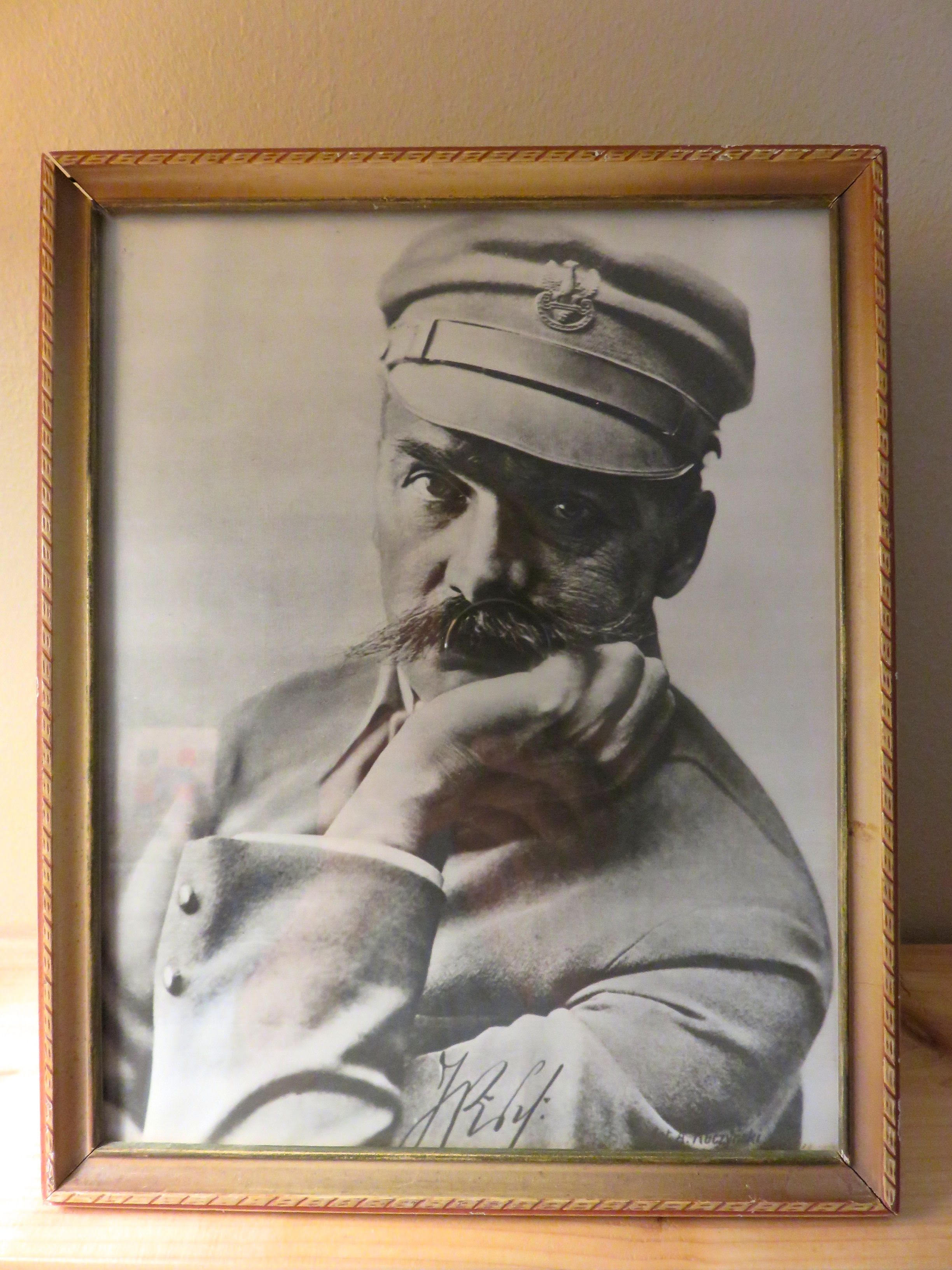
A photo-portrait of Marszałek Józef Piłsudski
Barbara Rylko-Bauer
I remember this photograph of Marszałek Józef Piłsudski from my earliest childhood, although I can’t recall where it sat in our first home, on Chopin Avenue in southwest Detroit.
2
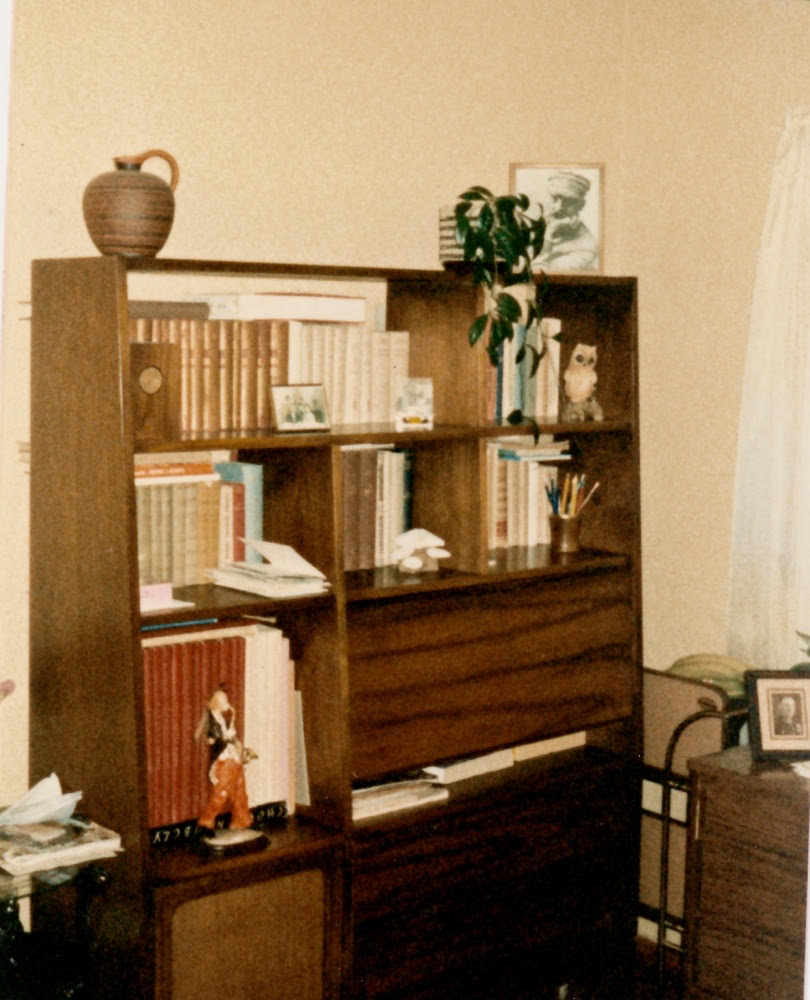
The photograph I’ve attached is from our second home on Detroit’s northeast side, on Rogge Street.  It sat in the spare room, on a bookcase that was filled with books from Poland (see below). And after my mother moved to Grand Rapids in 1984, she brought the bookcase and the photograph with her.  While I never asked her about the significance of it for her, I think that it represented both a symbolic connection to the Poland of her past and a tangible reminder of her husband/my father, who died in 1969 at the age of 74.
I do not know the origin of the photograph, although the frame has $1.50 penciled on the back, so it was clearly bought in the U.S. The photograph itself could have come with my parents when they emigrated from Germany to the U.S. in 1950, but it’s more likely that it was acquired once they arrived here. 
My parents were both deported forcibly from Poland during WWII. My mother, as a political prisoner, spent 15 months in various Nazi concentration and slave labor camps. My father, as a Colonel in the Polish army, spent the entire war as a German POW, in Oflag VIIA in Murnau. Thus, at the time of liberation from their respective camps, they had nothing from their former life in Poland. And since they emigrated from Germany without first returning to Poland, there were no objects accompanying them from that past life.
This photo-portrait must have been an important reminder of that Polish past, especially for my father. He had enlisted as a young man at the start of WWI with the Polish Legions of Józef Piłsudski, and after finishing his officer’s training in 1918, he served in the artillery during the Polish-Soviet war of 1919-1920.  Piłsudski was an important figure in his life, and his vision for a more pluralistic Poland was supported by both of my parents.
This history took on much greater significance for me, as I worked on a memoir/biography of my mother, which eventually became the book, A Polish Doctor in the Nazi CampsMy Mother’s Memories of Imprisonment, Immigration, and a Life Remade (U. of Oklahoma Press, 2014). In the process of researching the historical context of her narrative, I gained a greater understanding of Polish history and a better appreciation of my father's past, which I knew very little about because I was just 19 years old when he died.
3

Friday, August 2, 2019

Call for Submissions to PAHA Newsletter, Orzeszkowa's "Marta" and Bukowczyk on PAHA

Chicago Polish Parade, May 2019, Photo by Andrzej Mikolajczyk

PAHA members and friends are invited to submit ideas for short articles, book blurbs and reviews, conference announcements and reports, memoirs and interviews (all items up to 500 words with two photos), for publication in the PAHA Newsletter (ISSN 0739-9766). Send your ideas and submissions  the Newsletter Editor, Dr. Maja Trochimczyk, maja@polishamericanstudies.org add any questions and suggestions regarding the newsletters, as well as any information you would like to have included there. The deadline for the Fall 2019 issue is August 31.

Maja Trochimczyk at the Huntington Library, Photo by Susan Rogers

The PAHA Newsletter appears twice a year. It serves the membership as an official and informational bulletin. It is free with any PAHA membership. The newsletter brings up-to-date information on the activities of the PAHA Council as well as the association's individual members, and on the PAHA conferences, projects, and publications. We also publish short articles about the history of Polish diaspora, including family history of emigrants scattered around the world.  The newsletter is archived by the National Library in Warsaw, Poland, as one of the many documents about the cultural life of American Polonia.

You may read newsletters published since 2000 online on PAHA Website:
https://polishamericanstudies.org/text/78/newsletter-free.html

Below there are sample stories from PAHA Newsletter Fall 2018 issue.

Dr. John J. Bukowczyk with PAHA President, Dr. Anna Mazurkiewicz. Photo by Marcin Szerle.

PAHA’s Value to Polonia and to Its Members 
By John J. Bukowczyk 

Revised excerpts from “The Polish American Historical Association—Its Place, Role, and Legacy within the Field of U.S. Ethnic History,” keynote address given at the 75th Anniversary Conference of the Polish American Historical Association at Loyola University in Chicago, September 7, 2018.

First, PAHA, with its long history, has been an essential structural element in the organizational life of Polonia as an American ethnic group.  Sociologists would tell us that such “institutional  completeness” is important for the vitality of ethnic groups and their survival; and a historical society, encouraging the preservation of historical memory, is a vital part of that “completeness.”  Second, for a segment of Polish-American society (many of us I am sure would attest), PAHA has promoted a version of Polish ethnic identity, the alternative to which might have been (for many of us—scholars, teachers, intellectuals, professionals) marginality within or more complete and ethnically anonymous assimilation and absorption into our respective professions, institutions, disciplines, and neighborhoods and into the larger American society.  Third, through its efforts at partaking in the organizational, institutional, and intellectual activities of the historical profession in the United States, PAHA has advanced that perennial quest by members of one of America’s historically more marginalized and maligned white ethnic groups for respect and recognition.  In this sense, the lay Polish-American scholars who steered PAHA in recent decades have shared much in common with the nuns and priests who went before them; all have been, in a sense, emissaries, missionaries, and flag-bearers.

The Polish American Historical Association of recent decades has been especially significant within Polish America, I would argue, for modeling ways to “be Polish” in modern and post-modern American society and the globalizing contemporary world.  In practice it has erected a proverbial “big tent” of Polishness, welcoming members of all political opinions and ethno-cultural or ethno-religious backgrounds and affiliations.  The vision of Polishness that in recent years I think it has promoted has revolved around a belief that Polish Americans are united not by what they do, or how they think, or how they “perform” ethnicity—and especially not by any (racialist) belief that they share some fictive common “blood”—but by their shared commitment to advancing the study of one of America’s major ethnic groups and by their—by our—common history.

For us, Polonized has not meant polarized.  While no less honoring Polish cultural heritage, PAHA in recent decades has promoted a pluralist, secular, civic vision of Polishness, one, I might say, which evokes Jagiellonian and Enlightenment ideas about who may be a Pole.  Although the bulk of PAHA’s membership shares a Polish ethnic background, PAHA has not been an “ethnic” organization per se, but has welcomed a diversity of persons to membership and officer positions and has published and recognized scholarship on Polish-American topics regardless of the ethno-religious or ethno-cultural background of its authors.  Its conferences and other programs, meanwhile, have included—indeed, invited—participation by non-Poles.  PAHA’s established practices in this regard, conducted in a pluralist American society, could—should—become a model for Polish-American organizations and groups throughout America and throughout the Polish diaspora.  Indeed, they could be a model for other ethnic groups and even for nations throughout the world.

____________

John J. Bukowczyk is Professor of History at Wayne State University in Detroit and past president (1990-92) of the Polish American Historical Association. Author of A History of the Polish Americans (1987; New York: Routledge, 2017) and editor of Polish Americans and Their History: Community, Culture, and Politics (Pittsburgh: University of Pittsburgh Press, 1996), Bukowczyk also is the editor of the Polish and Polish-American Studies Series published by Ohio University Press. 


Translation of Orzeszkowa’s Marta 
Issued by Ohio University Press    

Ohio University Press has just published Marta, a pioneering feminist novel by 1905 NobelPrize finalist Eliza Orzeszkowa, as part of its Polish and Polish-American Studies Series. The book is translated by Anna Gąsienica Byrcyn and Stephanie Kraft, with an introduction by Grażyna J. Kozaczka. We think it has excellent potential for classroom use in women’s studies, Polish studies, and women’s writing, labor history, and nineteenth-century literature courses.  Of Orzeszkowa’s many works of social realism, Marta (1873) is among the best known, but until now it has not been available in English. Easily a peer of The Awakening and A Doll’s House, the novel was well ahead of the English literature of its time in attacking the ways the labor market failed women. An excerpt and Grażyna J. Kozaczka’s introduction, including discussion questions, are available here:

https://ohioswallow.com/extras/Marta_Excerpt.pdf. If you are an editor who is interested in a review copy for your journal or website, you can request one here: https://ohioswallow.com/request/review/OUP71G904J381 (for international requests, the press will hard copies at their discretion). If you are interested in assigning the book to a class, you can request a free pdf exam copy here:  ohioswallow.com/request/exam/OUP71G904J381

Prof. Grażyna Kozaczka commented about the book: “Orzeszkowa wrote Marta early in her career and the novel reflects her interest in the women’s issues. The novel focuses on a young sheltered genteel woman who has recently lost her husband and discovers how difficult it is to support herself and her small daughter. Without a safety net of a family, without education that could secure her a job, Marta learns quickly that the world can be quite hostile to a single woman. In her novel, Orzeszkowa offers a brilliant picture of Warsaw society during the second half of the 19th century as she follows her unfortunate heroine.”  The beautiful book cover features a reproduction of “Macierzyństwo,” a lovely painting by Olga Boznańska.


Monday, July 1, 2019

Nominate a Scholar, Community Activist, or Artist for a PAHA Award! Deadline on July 30, 2019


CALL FOR NOMINATIONS FOR PAHA AWARDS AND PRIZES

Nominations are sought for the following awards that will be presented by PAHA at its 77th Annual Meeting, in January 2020. The following award nominations must be received by July 30, 2019, via email to Chair of the Awards Committee, PAHA's Second Vice President, Dr. Marta Cieslak, at mxcieslak@ualr.edu.

  • Mieczyslaw Haiman Award is offered annually to an American scholar for sustained contribution to the study of Polish Americans.
  • Oskar Halecki Prize recognizes an important book or monograph on the Polish experience in the United States. Eligibility is limited to works of historical and/or cultural interest, including those in the social sciences or humanities, published in the two years prior to the year of the award.
  • Skalny Civic Achievement Award honors individuals or groups who advance PAHA's goals of promoting research and awareness of the Polish-American experience and/or have made significant contributions to Polish or Polish-American community and culture.
  • Amicus Poloniae Award recognizes significant contributions enhancing knowledge of Polish and Polish-American heritage by individuals not belonging to the Polish-American community.
  • James Pula Distinguished Service Award is given occasionally to a member of PAHA who has rendered valuable and sustained service to the organization. Since 2017, this award honors Prof. James Pula, PAHA's past president, current treasurer, and a long-time editor of the Polish American Studies.
  • Creative Arts Prize recognizes the contributions in the field of creative arts by individuals or groups who have promoted an awareness of the Polish experience in the Americas.
  • Established in 2018, the Joseph W. Zurawski Prize will be awarded for the best article or book published on the topic of Polish American screen images in films or television presented to audiences in the United States and released by American companies. To be eligible, works must have been published within the past three years. Nominations should be sent to the Awards Committee, Polish American Historical Association. Although there is no deadline, for the fullest annual consideration nominations should be made by June 1 each year. Awards will be presented at the awards ceremony during the annual PAHA conference in January.


JOSEPH W. ZURAWSKI PRIZE FOR STUDIES OF POLISH AMERICANS IN FILM OR TELEVISION IN THE U.S.

The Polish American Historical Association is pleased to announce creation of the Joseph W. Zurawski Prize. Consisting of a $500 award and a plaque, the  prize will be awarded for the best article or book published  on the topic of Polish American screen images in films or  television presented to audiences in the  United States  and released by American companies. To be eligible, works  must have been published within the past three years. Nominations should be sent to the Awards Committee, Polish  American Historical Association, Chair, Dr. Marta Cieslak, at mxcieslak@ualr.edu. Although there is no deadline, for the fullest  annual consideration nominations should be made by June 1  each year. Awards will be presented at the awards ceremony  during the annual PAHA conference in  January.


Joseph W. Zurawski has remained active in the Polish American community since writing his graduate thesis on Poland in 1960. He reviewed books on the Polish American community for several newspapers, was editor for Narod Polski, president of the Polish Museum of America, member of the Boards of the Polish Roman Catholic Union of America and the Polish Museum of America, and taught Polish American history and culture at Wright and Triton Colleges. He was an archivist of historical records for Saint Mary of Nazareth Hospital (known as "The Polish Hospital”), wrote several books including Polish American History and Culture: An Annotated Bibliography and, most recently, The Polish Presence in American Screen Images. Among the awards he received are: Outstanding Young Man of America, Chamber of Commerce (1963); Distinguished Service Certificate, Copernicus Quincentennial Commission (1973); the American Catholic Who’s Who (1976), Kosciuszko Medal, Kosciuszko Foundation (1977); Civic Achievement Award, Polish American Historical  Association (2002); “Wybitny Polak” (Outstanding Pole, culture category), Foundation of Polish Promotion, Chicago presentation a Chicago’s Polish Consulate, Warsaw culmination at Grand Theater and Polish National Opera (2017). He has been a proud member of the Polish American Historical Association for over 50 years.

GRADUATE STUDENT/YOUNG SCHOLAR TRAVEL GRANT, DUE JULY 30, 2019

PAHA encourages graduate students and emerging scholars (up to three years after graduation) to apply for a Travel Grant. Two such grants of $500.00 each will be awarded to offset travel costs to attend the 2020 PAHA Annual Meeting in New York. The grants will be awarded by the Program Committee for two best conference proposals dealing with the Polish American experience in any historical epoch, scholarly field, or aspect submitted by junior scholars.

To apply please submit the following documents to Chair of Awards Committee, PAHA's Second Vice President, Dr. Marta Cieslak, via email to mxcieslak@ualr.edu:
  • your paper proposal (as required by the general CFP)
  • a brief letter of application (no template will be provided)
  • a complete CV
  • one letter of recommendation from a senior scholar (e.g. thesis advisor).
In order to receive the travel grant it is mandatory to present the paper at the conference in person. Awardees will receive remuneration during the Awards Ceremony at the Annual Meeting. Failure to present the paper in person at the annual meeting shall result in the immediate cancellation of the grant.

The deadline for application, to be submitted with the paper proposal, is JULY 30, 2019.

Please send your application packets by email to chair of the Awards Committee, Dr. Marta Cieslak, at mxcieslak@ualr.edu, with the subject line "Graduate Student Travel Grant."

Saturday, May 25, 2019

Objects that Speak - Zither of a Compassionate Dreamer

PAHA Website includes a new section entitled "Objects that Speak" and curated by President Anna Muller.  In the introduction to the site Muller writes:

"In the collection of objects included on this site, PAHA hopes to engage with the history of Polish Americans, but also to reflect on the phenomenology of objects. The objects tell the stories of people who traveled across the Atlantic. Most of the objects were to help them fulfill their dreams of remaking their lives anew far away from home. While they symbolize the importance of the home left behind, they also testify to the Polish immigrants’/people’s efforts to imbue a new home with significance. One of the first stories that grabbed our hearts – the story that is included on the website – was the story of a photo from a grandfather’s passport – a terrific example of how some objects, with time, take on a separate life from the one that served their creation; and how many of them now play a role in the lives of future generations. The relationship between us and objects is fluid – they affect our lives, but we also change their purpose. The passport was a tool that helped the grandfather’s transition, but with time, for the younger generations, it became the symbol of that transition, and also a link to the past. Photos of objects send a message of the power of human agency, but also of an individual’s daily life – daily gestures of care that nourish the connection with the past for the future."

More information: 
http://polishamericanstudies.org/text/38/objects-that-speak.html

Below we reprint one of the posts from the site.


Zither of a Compassionate Dreamer

Taylor Lenze (with the help of Henrietta Nowakowski and Anna Muller)

The strummed notes of a zither are striking and clear, overlapping one another in harmony and vibrating in the wooden hollow of the soundbox. The curved, wooden, string instrument, somewhat like a gentler-sounding harpsichord with additional guitar strings, and the ability to play music on it has been vastly forgotten today. For Henrietta Nowakowski, however, the zither (cytra, she calls it) was always a touchstone of her life.

For Nowakowski, the zither was a part of her mother (Aniela Zapytowski’s) identity, a symbol of her dreams. It’s story began earlier though, tracing back beyond Nowakowski’s memory to her maternal grandparents, Aniela’s parents.

Nowakowski never met her grandparents. She knows that her mother’s father took care of horses on an estate. Being a younger son in a family of multiple children, he hadn't inherited land from his own father and instead had to travel with his trade. His wife, [Nowakowski's grandmother], who passed away when little Aniela was 10 or 11 years old, must have been a strong, knowledgeable woman because professionally she was a herbalist. People came from all over her region to be cured by her.

After Aniela’s mother’s death, her father remarried. Aniela’s youngest sister was most impacted by the changing circumstances and was mistreated by her new stepmother. Eventually she couldn’t bear it, and at 16, set out for on a journey in hopes of a new life in America, a monumental decision for a young person without question, but one which would have ripple effects throughout the entire family and future generations.

This determination and courage, shared by late mother and youngest daughter is also apparent in Aniela’s story. Aniela, a middle daughter in the five children, was also a strong professional woman, matriarchal, determined and independent. Trained in sewing, Aniela worked in Lwów for an Austrian family as a seamstress and governess. Her hard work and practicality didn’t signify a brevity of imagination, however. Aniela was a dreamer, always thinking of other places and possibilities. In 1913, she and her older sister decided to make a short visit to the youngest sister, traveling by ship in second-class from Bremerhaven to the US where the young woman now lived in Philadelphia. Traveling second (rather than third) class on the ship was a big deal, and only possible because of Aniela’s own efforts and work as a seamstress (Zakład Krawcowy in Lwów). Nowakowski recounts with pride that they paid their own way and must have saved for their passage. 


Aniela herself was only 26. The beautiful wooden zither was clearly one of her cherished possessions because she included it among her necessities. Apart from the instrument and some pictures, Nowakowski has just a few other momentos her from her mother's European life. "I also have a picture of dried edelweiss flowers, a souvenir of my mother’s visit to Austria, where she accompanied her Austrian employer," Nowakowski recalls. Aniela once recounted seeing the operetta “The Merry Widow” in the Burg Theatre in Vienna during this trip. Her daughter now deduces that "judging by the time period, it must have been just at the time that this work by Franz Lehar premiered. The card with the dried ‘szarotki’ had to have been important to my mother since I remember that in the late 1940’s, about 30 years later, she went to a lot of effort to have the card beautifully framed. It’s now in my living room." Slowly, by looking at the objects and by going deeper in her memories, Nowakowski begins to piece together the story.

In Philadelphia, Nowakowski knows that the three sisters met up just as the war broke out. Though unexpected and probably not in line with Aniela’s plans for her life, she made the best of the compulsion to stay in the US and fell back on her sewing skills to support herself, finding work as a seamstress. A single woman forced to survive in a foreign country, Aniela could have become hardened and rough by the stress and work, but perhaps it was the zither and her music which allowed her to stay “soft hearted and tender” as Nowakowski remembers. Eventually Aniela moved to Pittsburg, becoming active in the Polish Falcons, a Polish paramilitary organization.

It was here that love struck. At the Pittsburgh Falcon Nest, Aniela met her husband and Henrietta's father, Ignacy Zapytowski. Also from the Lwów area, he had served in the Austrian army and first at age 24 immigrated to America (in 1907). In Pittsburg, he enlisted to go back to Europe and fight with the Polish Army in WWI. This decision stirred turmoil in his family because there was the potential the family would be fighting against itsself.

After his safe return to the US at the conclusion of the war, he and Aniela were married. Both remained very active in Polish military organizations, however. Ignacy’s work brought him to Detroit (where he could use his cabinetmaker skills as a wood model maker for future cars), Aniela assumed directorship of a woman’s group, headquartered in Detroit, which worked to help returning Polish veterans.

The couple had four children, two sons and two daughters. Though busy as a working mother, Aniela still tried to play the zither, actively seeking out sheet music for it, in addition to the ones she brought from Poland. Probably because it was such an uncommon, specific instrument, the only music she had was that which a piano tuner gave her. Assumedly she could not play by ear but relied on written notes.


By the mid 30s Aniela had stopped both working and playing the Zither. It was badly in need of tuning and fixing but there was no one with the necessary knowledge and skills to do the work. This may have been heartbreaking, a tangible severing of Aniela’s connection to her past, home and dreams of returning. But if so, she didn’t express this to her children nor allow it to break her soft spirit and love of music. Even though, from the earliest Nowakowski can remember, the Zither was hidden away out of sight, the house remained full of music and dreams. Nowakowski and her older sister both took piano lessons and practiced on the piano at home, continuing their mother’s tradition.

By this time, Aniela's dreams of returning to Poland were also lovingly put aside like her instrument. Though she and Ignacy had always wished to return home, the depression had wiped out their savings. Based on a copious amount of postcards and letters, it's assumed that Ignacy traveled frequently with work before marriage, but the family was never able to permanently relocate to Poland. Despite this too, Nowakowski recalls how her mother always remained a "very compassionate dreamer," full of softness and hope. Over and over again, Aniela’s strength and grace showed through as she adjusted to circumstances beyond her control and continued on ungrudgingly.

Unfortunately, the instrument hasn't held up as well to hardship. After being stored 15 years in a humid basement, the instrument's wood split beyond repair. Nowakowski recovered the instrument in the 90s when her sister moved to Alaska and has preserved and protected it ever since. Not able to play the Zither herself, she nevertheless cherishes the link it represents for her to her mother’s dreams and desires to learn.