Showing posts with label Aquila Polonica. Show all posts

Tuesday, May 10, 2016

Books on Polish and Polish American Subjects at Book Expo America in Chicago, May 2016


Polish American titles will be represented  at the Book Expo America (BEA) and BookCon Chicago (May 11 -14, 2016), which is the largest book show in the US. It will be held in Chicago this year in mid-May, and Poland is the featured country. The Poland exhibit is being managed by the Book Institute in Krakow and the Polish Cultural Institute in NYC, in collaboration with Aquila Polonica, a publisher of books on WWII experience in Poland and beyond.
Aquila Polonica's Terry Tegnazian  was asked to organize a “Books in English” section within the Poland exhibit. Thedisplay includes a generous selection of fiction and non-fiction books on Polish history published by Aquila Polonica, as well as poetry collections by John Z. Guzlowski's Echoes of Tattered Tongues (Aquila Polonica, 2016), Maja Trochimczyk's Slicing the Bread (Finishing Line Press, 2014), Trochimczyk's Chopin with Cherries anthology (Moonrise Press, 2010), Cecilia Woloch (Carpathia), Oriana Ivy (April Snow), Stuart Dybek (I Sailed with Magellan), and Linda Nemec Foster (Amber Necklace from Gdansk).


John Z. Guzlowski's Echoes of Tattered Tongues 

 Published by Aquila Polonica in March 2016, this critically acclaimed books has already attracted many positive critical responses. Foreword Reviews, one of the leading publishing industry trade media, chose Echoes of Tattered Tongues: Memory Unfolded, as one of only six books to highlight in its Poetry Feature in the Spring 2016 issue.

 Maja Trochimczyk wrote in Cosmopolitan Review:  “Some books take a lifetime to write, yet they can be read in one sleepless night, filled with tears of compassion and a heaviness of heart. John Z. Guzlowski’s book of poetic memoirs is exactly such a book: an unforgettable, painful personal history, distilling the horrors of his parents’ experiences in German labor and concentration camps into transcendent artwork of lucid beauty.” (January 2016)

www.cosmopolitanreview.com/echoes-of-tattered-tongues/

The publisher writes: "In this major tour de force, John Guzlowski traces the arc of one of the millions of immigrant families of America, in this case, survivors of the maelstrom of World War II.  Raw, eloquent, nuanced, intimate—Guzlowski illuminates the many faces of war, the toll it takes on innocent civilians, and the ways in which the trauma echoes down through generations. His narrative structure mirrors the fractured dislocation experienced by war refugees. Through a haunting collage of jagged fragments—poems, prose and prose poems, frozen moments of time, sometimes dreamlike and surreal, other times realistic and graphic—Guzlowski weaves a powerful story with impacts at levels both obvious and subtle. The result is a deeper, more visceral understanding than could have been achieved through descriptive narrative alone."

"This is the story of Guzlowski’s family: his mother and father, survivors of the war, taken as slave laborers by the Germans; his sister and he, born soon after the war in Displaced Persons camps in Germany; the family’s first days in America, and later their neighbors in America, some dysfunctional and lost, some mean, some caring and kind; and the relationships between and among them all. As Guzlowski unspools the story backwards through time, he seduces us into taking the journey with him. Along the way, the transformative power of the creative process becomes apparent. Guzlowski’s writing helps him uncouple from the trauma of the past, and at the same time provides a pathway for acceptance and reconciliation with his parents. Ultimately, then, this is a story of healing."

"Because America is a land of immigrants with myriad and varied pasts, Guzlowski’s story may reflect pieces of your own family’s history, though details will of course differ. Something similar may also be the hidden story of one of your friends, or a colleague at work, or the sales clerk or waiter who serves you one day…or even, like Guzlowski, your professor of English literature"
.
Visit Echoes of Tattered Tongues: Memory Unfolded website:
http://www.polandww2.com/echoes-of-tattered-tongues/

Visit the Aquila Polonica Schedule of Events at BEA 2016:
http://www.polandww2.com/2016-articles/bea-2016-schedule


_______________________________

Maja Trochimczyk edited Chopin with Cherries to celebrate the 200th anniversary of the birth of Chopin, and a number of Polish-American and American poets contributed their verse to celebrate the great composer, known very well on both sides of the ocean and around the world.


Chopin with Cherries: A Tribute in Verse 
edited by Maja Trochimczyk

This volume celebrates the 200th birth anniversary of Polish pianist-composer, Fryderyk Chopin (1810-1849). Ninety-one poets are represented here; they live in the U.S., England, France, Mexico, the Philippines and Poland - with family roots in Poland, Australia, China, France, India, Italy, Malta, Mexico, the Philippines, Serbia, and other countries. The anthology includes more than 122 poems in English, and one important Polish poem, Cyprian Kamil Norwid's Fortepian Szopena, in a new English translation by Leonard Kress (this is the first English translation of Norwid's masterpiece, considered too difficult even by the translator of his entire oeuvre, Adam Czerniawski). English-language classics include verse by T. S. Elliot, Emma Lazarus and Amy Lowell.

Chopin is heard everywhere: in a Parisian church (Rick Lupert), on the plains of North Dakota (Thom Tamarro), in Ohio (Donna L. Emerson), in his birthplace in Zelazowa Wola (Margaret C. Szumowski), and on the radio (Ryan McLellan). Marian Shapiro considers the meaning of Chopin's art "as if each measure were a casual ripple in a spring stream of melting centuries." Australian-born poet Katrin Talbot envisions Chopin's music as an accusation for our failures:"'Why didn't you . . . ? Why did you . . . ?'" John Guzlowski writes about Chopin's music replacing traumatic memories of "the hollow surge and dust of German tanks" ("A Good Death"). Ruth Nolan hears Chopin in the desert, "between the spaces of darkness and sound, blown across the sand dunes into magnificence." Poets fondly remember playing or listening to the music associated with their childhood, evoking moments of happiness and feelings of nostalgia or loss (Trochimczyk's "A Study with Cherries" that gave rise to the title of the collection).

"The book's striking title brings the reader to Trochimczyk's own poem, "A Study with Cherries," where the musical motifs of one of Chopin's etudes transport the poet across space and time to the cherry orchard of her grandparents in Poland and offer her peace and fulfillment.... In Chopin with Cherries: A Tribute in Verse, just a glance at the chapter headings identifies the poetic interests in Chopin. Thus poets find inspiration in a particular musical genre such as waltzes, mazurkas, or nocturnes; they become fascinated by Chopin's life, illness, and death, and his relationship to George Sand; and, finally, they explore their own emotional responses to hearing or playing Chopin's music...." (From a review by Prof. Grazyna Kozaczka, The Polish Review, vol. 58 no. 4 (Winter 2013): 109).

"For those who have been moved by the music of Fryderyk Chopin, this new international anthology will be a treat... One breathtaking aspect of the anthology is the diversity of voices, both stylistically and geographically... [Among] the striking aspects of the anthology is the way in which the editor, Polish born Maja Trochimczyk, arranges the various sections, not only by musical forms, but also into sections like beauty and death, words that often come to mind when considering Chopin's life, his passions and his early demise." Christopher Woods in Contemporary World Literature no. 5 (February 2011).

For more information, visit Moonrise Press's site: http://www.moonrisepress.com/chopin.html


Slicing the Bread: Children's Survival Manual 
by Maja Trochimczyk


This unique poetry collection revisits the dark days of World War II and the post-war occupation of Poland by the Soviet Union that “liberated” the country from one foreign oppression to replace it with another. The point of view is that of children, raised by survivors, scarred by war, wary of politics. Children experienced the hunger and cold, witnessed the killings, saw the darkening blood spilled on the snow and hands stretching from locked boxcar windows. Some heard the voices of murdered Jews like “bees in the breeze,” others learned never to throw any food away, because “war is hunger.” The poems, each inspired by a single object giving rise to memories like Proust’s madeleine (a spoon, a coat, the smell of incense) are divided into three sections, starting with snapshots of World War II in the Polish Borderlands (Kresy) and central Poland. Reflections on the Germans’ brutal killing Jews and Poles are followed by insights into the way the long shadow of THE war darkened a childhood spent behind the Iron Curtain.

 For poet Georgia Jones Davis, this book, “brings the experience of war into shocking, immediate focus” through Trochimczyk’s use of “her weapon: Language at its most precise and lyrical, understated and piercingly visual.” According to Pulitzer-Prize nominated poet John Guzlowski, Maja’s “poems about what the Poles suffered both during World War II and The Cold War afterwards are written with the clarity of truth and the fullness of poetry… Here are the stories of how the people she loved experienced hunger and suffering and terror so strong that it defined them and taught her, and teach us, the meaning of family.” The Tieferet Prize winner and Poets-Café host Lois P. Jones points out that “Maja brings the Warsaw of her youth and that of her ancestors into vivid and heartbreaking detail. These are words that will move you to appreciate the simple privileges and necessities of life. Slicing the Bread is a feast in our universal and ever present famine.” As Jones wisely observes “It is the duty of the poet to convey story, but it is the art of the poet who can transform our often cruel and brutal history and affect forever, the way we look and listen to the world.”

Historical marker of a Nazi massacre of civilian Poles, by Maja Trochimczyk


__________________________

 The Books in English section of BEA "Poland" display will show more than 100 books in English about Poland—including works of fiction, history, cookery, music, and much more—by a variety of publishers and authors. In addition to books of poetry by Guzlowski, Trochimczyk, as well as by Cecilia Woloch, Stuart Dybek, Oriana Ivy, and Linda Nemec Foster,  there are stories and novels by Maria Pilatowicz (Walking on Ice), Stuart Dybek, John Minczeski, Krysia Jopek, Leslie Pietrzyk, and James Mitchener. The memoirs include the Color of Courage by Julian Kulski.
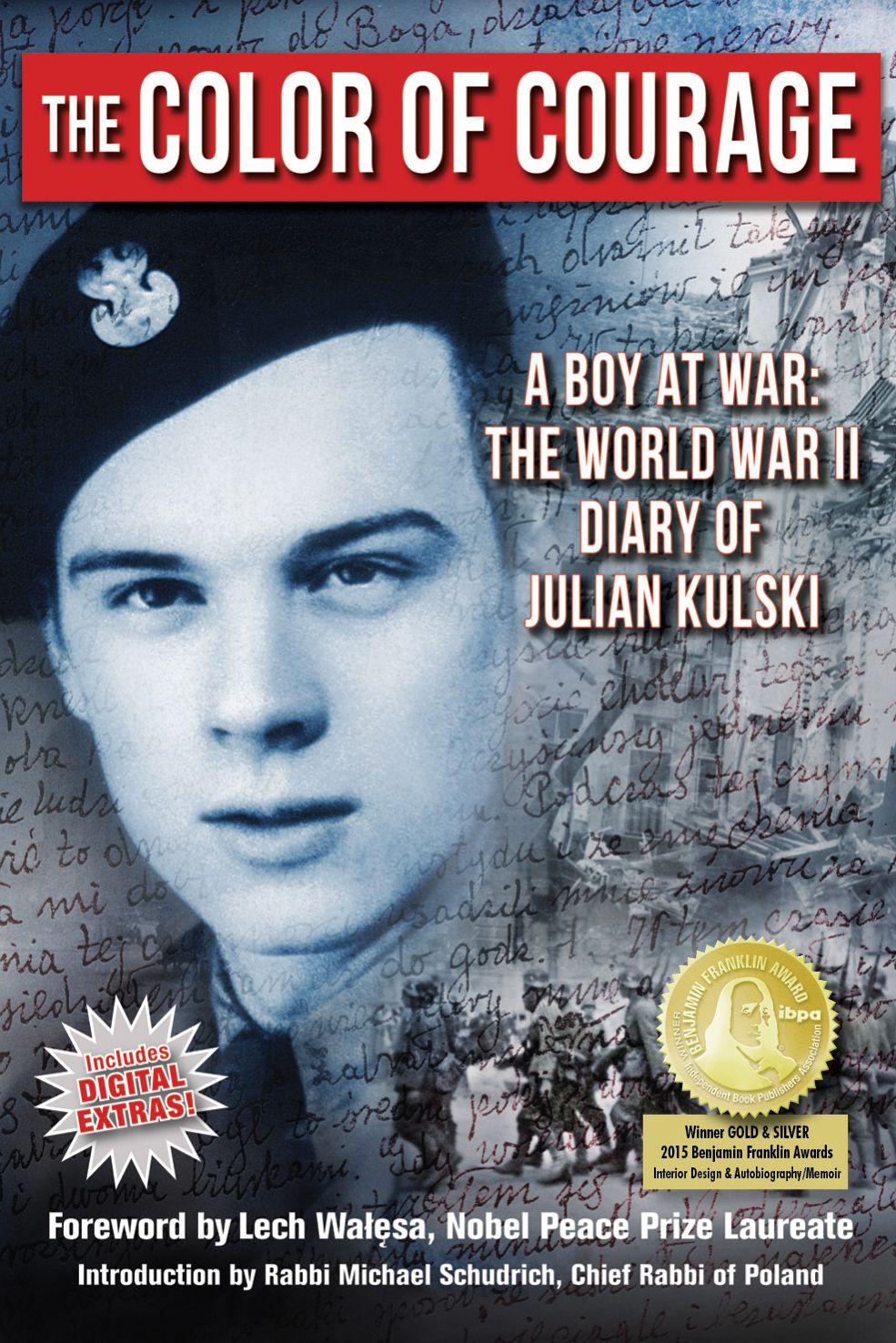


The Color of Courage by Julian Kulski 

Aquila Polonica presented also the Color of Courage: A Boy at War: The World War II Diary of Julian Kulski (2014). This remarkable diary of a boy at war from ages 10 to 16 presents the thoughts, ideals, and actions of a young boy in occupied Poland. As the war unfolds through his eyes, we are privileged to meet a rare soul of indomitable will, courage and compassion. Kulski, the son of the Deputy Mayor of Warsaw, is a 10-year-old Boy Scout when the Germans invade Poland in September 1939. He soon begins waging his own private war against the Germans with small acts of sabotage.

At age 12, Kulski is recruited into the clandestine Underground Army by his Scoutmaster and begins training in military tactics and weapons handling. At 13, he accompanies his commander on a secret mission into the Warsaw Ghetto to liaise with leaders of the Jewish Resistance. Arrested by the Gestapo at age 14, Kulski is incarcerated in the notorious Pawiak Prison, beaten, interrogated at Gestapo headquarters, and sentenced to Auschwitz. After being rescued, he joins the Ninth Commando Company of the Underground Army, and at age 15 fights in the Warsaw Uprising of 1944. Taken prisoner by the Germans, 16-year-old Kulski ends the war in a POW camp, finally risking a dash for freedom onto an American truck instead of waiting for "liberation" by the Soviets.

Read more about this book: http://www.polandww2.com/color-of-courage/color-of-courage-about-the-book

My Sister's Mother by Donna Urbikas   

Donna Solecka Urbikas grew up in the Midwest during the golden years of the American century. But her Polish-born mother and half-sister endured dehumanizing conditions during World War II as slave laborers in Siberia. War and exile created a profound bond between mother and older daughter, one that Donna would struggle to find with either of them. At four o’clock in the morning on February 10, 1940, Janina Ślarzynska and her five-year-old daughter, Mira, were taken by Soviet secret police from their small family farm in eastern Poland and sent to Siberia with hundreds of thousands of others. So began their odyssey of hunger, disease, cunning survival, desperate escape across a continent, and new love amidst terrible circumstances.  After the war, Mira, Janina and her new husband—a Polish Army officer who had helped them escape the Soviet Union—are haunted by the past. Baby boomer Donna, born in post-war England and growing up in 1950s Chicago, yearns for a “normal” American family. In this unforgettable memoir, Donna recounts her family history and her own survivor’s story, finally understanding the damaged mother who had saved her sister.

The book has been described as “a gripping study of family dynamics, this is also a must-read for World War II history buffs” by Leonard Kniffel (author of A Polish Son in the Motherland) and “an unprecedented saga of a loving mother and her two daughters raised years and oceans apart . . .A unique perspective on the tragic deportation of Poles to Siberia” by Wesley Adamczyk (author of When God Looked the Other Way).  Allen Paul concluded: “. Her book is a primer for all who seek to understand the harrowing journey of the Poles during this fateful period."  Events are planned at the Kosciuszko Foundation on May 7 and at the Polish Museum of America in Chicago on May 22. More information www.danutaurbikas.com.

The catalogue of all books in English on display at BEA is found on Aquila Polonica website: 

http://www.polandww2.com/images/RESOURCES/BEA2016BookEnglish-LoRes2.pdf


_________________________

Non-fiction and memoirs by Polish-American authors include Across the Atlantic: The Adamowicz Brothers, Polish Aviation Pioneers by Zofia Reklewska Braun and Kazimierz Braun (Moonrise Press, 2015). Among memoirs are Memoirs of Helena Paderewska edited by Maciej Siekierski, and memoirs about WWII traumatic experiences of their mothers by Donna Urbikas and Barbara Rylko Bauer.
Other books include titles on Polish history, such as Alex Storozynski's Kosciuszko,  Polish American history (Anna Jaroszynska Kirchman's The Polish Hearst), the two-volume collection of studies edited by Anna Mazurkiewicz, East Central Europe in Exile, as well as books on politics, sociology, literature and music. The latter consists of a whole series of titles published by the Polish Music Center at USC, two books published by Marek Zebrowski, both about Ignacy Jan Paderewski, Chopin and Paderewski, and Paderewski in California, and William Smialek's and Maja Trochimczyk's The Frederic Chopin: A Research and Information Guide (Routledge 2015) is also on display. 


Geraldine Prusko's Journey to Polonia 


(by Grazyna Kozaczka)

Journey to Polonia, Book One: The Polish Americans (Indianapolis: Dog Ear Publishing, 2015), Geraldine Prusko’s debut novel, takes on an ambitious topic of the epic journey of thousands of Polish peasants from the reality of poverty and persecution in the partitioned Poland of the late 1800s to the dream of prosperity and freedom in the United States. The information on the book cover suggests that Prusko’s own family stories of emigration from Poland inspired this novel, which the author promises to be the first one in a series.

The narrative begins in 1965 in Milwaukee, Wisconsin with a dramatic scene of a sexual assault on a teenage girl returning home from school on a dark winter afternoon. As in many similar situations, the rapist is known to Olivia Medjeski – he is a cousin. And as in many similar situations at the time, Olivia is urged by the women in her family, by her mother and her grandmother, to just forget what happened to her, to keep quiet so she would not be blamed for the attack and further victimized by the community.

Yet how can this high school senior deal with the feelings of fear, disgust, guilt, and shame, while keeping it all to herself? Her mother suggests a way to begin the healing process: Olivia should investigate the history of her family, a family of Polish immigrants who settled in Milwaukee in the 1890s. For Olivia, the past creates a badly needed distraction and allows her to learn about some extraordinary women who endured many hardships as they kept their families together and continued Polish traditions in the new land.

Olivia’s investigation provides the framework for Prusko’s plot, constructed of separate stories chronicling the journey to America of Olivia’s four sets of great-grandparents. At first the reader gets to know Olivia’s ancestors within their original Polish setting. For the most part, they are all peasants although some of them managed to gain some education. Through their stories, Prusko investigates different reasons for peasant emigration and with great sensitivity shows the trauma of emigration: the leaving behind of all that was familiar and loved to venture into the frightening unknown. Some of the best, but also most disturbing, chapters of Journey to Polonia deal with the journey itself, from Polish villages by horse-drawn carts and trains, through Prussian ports and finally the ocean crossing in steerage to reach the port of New York.

Journey to Polonia is a chapter in the Polish American narrative albeit a family one. However, in the future editions of this novel, the author should consider changing the map insert to include an accurate representation of the partitions of Poland: Krakow was not a part of the Russian Empire. Likewise, it might be helpful to readers unfamiliar with Polish history to include precise information about the partitions.

______________

NOTE: Items about books by John Guzlowski, Donna Urbikas and Geraldine Prusko are reprinted from PAHA Newsletter Vol. 73 No. 1, April 2016.

Friday, April 17, 2015

Terry Tegnazian's Update - New Awards for Aquila Polonica


Terry Tegnazian, publisher of Aquila Polonica, is the recipient of PAHA's Amicus Poloniae Award for 2014.  Her title to fame is her publishing house, dedicated to Polish history. Aquila Polonica has recently been recognized by yet another set of awards.

 The Color of Courage—A Boy at War: The World War II Diary of Julian Kulski (Aquila Polonica Publishing, Nov. 2014) won the Gold Award for Interior Design (1-2 Color) and the Silver Award for Autobiography/Memoir in the 2015 Benjamin Franklin Awards. Winners were announced at a ceremony held in Austin, Texas, Friday evening, April 10, 2015. Now in its 27th year, the Benjamin Franklin Award, sponsored by the Independent Book Publishers Association (IBPA), is the premier awards competition in independent publishing, recognizing excellence in independent publishing. There were nearly 1,400 entries this year. More info at:
www.polww2.com/2015BenFranklinAwards

In his Foreword to this remarkable diary of a boy soldier during World War II, Nobel Peace Prize Laureate Lech Walesa calls The Color of Courage “a superb lesson of humanity.” The Chief Rabbi of Poland, Rabbi Michael Schudrich, writing the Introduction to the book, praises The Color of Courage as “an inspiring read.” Dr. Zbigniew Brzezinski, Center for Strategic & International Studies, says: “Compelling, readable, and very moving.”

“We’re absolutely thrilled to learn that The Color of Courage has won the 2015 Benjamin Franklin Awards,” said Aquila Polonica president Terry Tegnazian. “It’s so exciting to be both a Gold and a Silver winner! We knew we had something special with this rare look at World War II through the eyes of a young boy soldier, and we took special care in creating the book. We’re gratified that the Ben Franklin judges agree with us!” To learn more: www.polww2.com/AboutCourage

Julian Kulski was a 10-year-old Boy Scout living in Warsaw when the Germans invaded Poland in 1939. His diary follows his wartime experience from ages 10 to 16. He quickly begins his own personal war against the Germans with small acts of sabotage but soon, at age 12, is recruited into the Underground Army by his Scoutmaster, where he is trained in weapons handling and military tactics. Kulski undertakes a secret mission into the Warsaw Ghetto, is captured by the Gestapo, beaten, sentenced to Auschwitz, rescued, fights in a Commando unit during the vicious street fighting of the 1944 Warsaw Uprising, and ends as a 16-year-old German POW...finally risking a dash for freedom onto an American truck instead of waiting for “liberation” by the Soviets. Watch the book trailer: www.polww2.com/CourageTrailer

Kulski’s diary is enriched by more than 150 photos and illustrations, 13 maps, and 11 “Digital Extras,” which are short videos created by Aquila Polonica from historical film and audio material that bring Kulski’s story to life in an unprecedented way. Watch sample Digital Extras: www.polww2.com/SampleDigitalExtras

Interior design, typesetting and cover art are the work of talented Los Angeles designer Ewa Wojciak, Senior Lecturer of Fine Arts at the USC Roski School of Art and Design. Although this is her first book for Aquila Polonica, Wojciak has an extensive background as a designer and creative director primarily for the entertainment industry, with a client list that includes Disney, CBS, HBO, Sony, Universal Pictures and Fox, as well as in advertising agencies and print media. Winning the Gold Award for her design of The Color of Courage, Wojciak brings a fresh, contemporary look to this historical memoir, with pull quotes that draw the reader through the text, organic placement of images within the text, and an innovative use of thumbnail images and QR codes augmented by URLs to incorporate the multimedia Digital Extras into the print book.

Aquila Polonica is an award-winning independent publisher based in Los Angeles, specializing in publishing the Polish WWII experience in English. The company is a member of the Association of American Publishers (AAP) and the Independent Book Publishers Association (IBPA). Aquila Polonica’s titles are distributed to the trade in the U.S., Canada, U.K., Europe, Australia and New Zealand by National Book Network, www.nbnbooks.com.

All of Aquila Polonica’s books to date have won one or more awards. Aquila Polonica titles have been reviewed in major media such as The New York Times, The Atlantic, The New Republic and Publishers Weekly; they have been chosen as Selections of the History Book Club, the Military Book Club and the Book-of-the-Month Club; audio rights have been acquired by Audible.com and Brilliance. Translation rights for various titles have been acquired by foreign publishers in a number of countries—including most recently Brazilian rights to The Color of Courage, which were acquired by Editora Valentina.

See more at: www.AquilaPolonica.com

Sunday, January 11, 2015

PAHA Announces its Annual Awards at the 72nd Meeting, New York, Jan. 2015


Times Square, NY.  Photo by Maja Trochimczyk

The 72nd Annual Meeting of the Polish American Historical Association began with the Award Ceremony and Dinner Reception at the Consulate General of the Republic of Poland in New York, on January 2, 2015. Consul General, Hon. Urszula Gacek welcomed the guests and recounted the history of PAHA and its role in the documentation and promotion of Polish American history and culture.

Consul Hon. Urszula Gacek. Photo by Scott Whittle

PAHA President, Dr. Thomas Napierkowski, assisted by Dr. Pien Versteegh, PAHA's Executive Director, presented the awards and prizes to the following awardees. These remarks are based on the presentation speeches.

Photo by Marcin Mazurkiewicz

Mieczyslaw Haiman Award “offered annually to an American scholar for sustained contribution to the study of Polish Americans” was presented to NEAL PEASE  – Professor of History, University of Wisconsin-Milwaukee.

Neal Pease has an extensive record of valued publications in the field of Polish and Polish American history, including a well-received book on the Roman Catholic Church in interwar Poland: Rome's Most Faithful Daughter: The Catholic Church and Independent Poland, 1914-1939. (Athens: Ohio University Press, 2009). Neal was also an associate editor and major contributor to The Polish American Encyclopedia (2011). His contributions to the study of the Polish-Americans includes research in the area of American sports: “Diamonds Out of the Coal Mines: Slavic Americans in Baseball” (in The American Game: Baseball and Ethnicity, 2002) and “Big Game on the South Side: A Milwaukee Baseball Mystery Decoded."  His article on “The Kosciuszko Reds, 1909-1919: Kings of the Milwaukee Sandlots,” published in the Polish American Studies (2004), won the Swastek Award.

Photo by Scott Whittle

Furthermore, Pease's publications include numerous works on Polish history that have greatly contributed to the expansion of knowledge about Poland and thus actively encouraged the study of the Polish history, culture, and tradition in the United States. Notably, Neal Pease has been active in presenting academic papers and organizing panels at PAHA meetings for decades. He has served as President of PAHA and been active on its Board for a number of years. He is currently a member of editorial board, Polish American Studies. He is the newly appointed editor of The Polish Review and previously did excellent work as Book Review Editor for this same journal. He is also a member of the Board of Directors of the Polish Institute of Arts and Sciences of America.

In Milwaukee and Wisconsin, Neal has been a member of the Polish Studies Committee of the University of Wisconsin, Milwaukee for more than twenty-five years and has served several stints as chair of this very active and respected committee.  At UWM he teaches courses in Polish history. He is active in Milwaukee Polonia, both in the Polish Heritage Alliance of Wisconsin and its annual Polish Festival and in the Wisconsin Polish American Congress. He is ever ready to volunteer his time and talents whether invited to lecture on Polish and Polish American themes to local communities or to national and international academic audiences.

Photo by Marcin Mazurkiewicz.

The Distinguished Service Award “given occasionally to a member of PAHA who has rendered valuable and sustained service to the organization” was presented to Dr. MAJA TROCHIMCZYK - Editor, PAHA Newsletter and Online Communications Director

 Dr. Trochimczyk joined the PAHA Board as Editor of PAHA Newsletter in 2009 and has redesigned and expanded the newsletter to include a variety of short articles about the Polish American experience, including features on personal immigration histories, Polonia organizations, anniversary celebrations, new or forthcoming books, and other items of interest to the organization. The newsletter is illustrated and well designed.  In 2012, in order to provide a more efficient and faster communications resource to the organization, Dr. Trochimczyk created  a blog called PAHANews.blogspot.com, which to date has 38 posts that include information about PAHA awards, program deadlines, and reprints of selected general interest stories from the PAHA Newsletter. The blog has had over 13,700 views and has become an important venue for publicizing the activities of the organization. She has also contributed to the expansion of the PAHA Facebook page and is one of its co-facilitators, making frequent posts and comments. The Facebook page has over 1950 readers. In 2014, Dr. Trochimczyk redesigned PAHA's print publicity materials (a trifold flyer and a postcard) that used artwork by Julian Stanczak, PAHA's Creative Arts Prize winner.

Photo by Scott Whittle

As a scholar, Dr. Trochimczyk has previously received the PAHA's Swastek Prize in 2007 for the best article published in the Polish American Studies, “The Impact of Mazowsze and Sląsk on Polish Folk Dancing in California” that appeared in Vol. 63, No. 1 (Spring 2006). Article URL: http://www.jstor.org/stable/20148738. A musicologist and a poet, in 2014, Dr. Trochimczyk co-edited two books on Polish music: Frederic Chopin: A Research and Information Guide  (with William Smialek, for Routledge in New York) and The Lutoslawski Legacy (with Stanislaw Latek, for the Polish Institute of Arts and Sciences of Canada).  Her  books  include: Polish Dance in California (East European Monographs, distributed by Columbia University Press, 2007) and her most recent poetry publication, Slicing the Bread (2014) based on childhood memories of her parents who survived WWII in Poland. The Polish American Studies published three articles, including, in addition to the folk dance project, also studies of poetry about Chopin and images and myths about Ignacy Jan Paderewski.  Results of her research on Polish and Polish-American music of the 19th and 20th centuries  have been published in a range of books and journals, including the Polish Review, Musical Quarterly, Muzyka, Journal of Musicological Research, Contemporary Music Review, Computer Music Journal, and books published by Oxford University Press, Indiana University, Cambridge Scholars, Musica Iagellonica, among others. She also contributed 38 entries on music and dance to the Polish American Encyclopedia in 2011, and edited the Polish Music Journal for six years. (www.trochimczyk.net).


Terry Tegnazian with her most recent book and Anna Mazurkiewicz.
Photo by Scott Whittle.

The Amicus Poloniae Award “recognizes significant contributions enhancing knowledge of Polish and Polish-American heritage by individuals not belonging to the Polish-American community” and was presented to Ms. TERRY TEGNAZIAN, the co-founder of the Aquila Polonica Publishing.

Ms. Tegnazian was recognized for her devotion to printing books about Poland in World War II which nurture interest in and have an impact on the perception of Poland and Poles among the American audiences. A graduate of Brown University and Yale Law School, Terry Tegnazian became interested in the Polish experience of World War II as a result of research for a book she was working on about a Polish airman in the Battle of Britain. Reading memoirs of key Polish Underground leaders, she was moved by the stories of the Poles’ incredible courage during World War II—an aspect of the war she had not previously been aware of. Terry co-founded Aquila Polonica Publishing because she felt it was important that such lost stories be restored to history and the wider public.

Photo by Scott Whittle

She has visited Poland several times in recent years.  In addition to being a hands-on publisher involved in all aspects of each Aquila Polonica title, Terry has written about Poland in World War II for the Wall Street Journal Europe and the Warsaw Business Journal, she's been interviewed on national television, and has presented numerous live programs in a wide range of venues, including museums and libraries, university courses, and the Polish Consulate (Montreal) and Embassy in Canada.

Dr. Anna Mazurkiewicz with Pres. Tom Napierkowski. Photo by Scott Whittle

The Oskar Halecki Award “recognizes an important book or monograph on the Polish experience in the United States” and was presented to Dr. ANNA MAZURKIEWICZ of the University of Gdansk, Poland.

Dr. Anna Mazurkiewicz served as the editor of East Central Europe in Exile, vols. 1-2: Transatlantic Migrations, and  Transatlantic Identities (Newcastle upon Tyne: Cambridge Scholars Publishing, 2013). This outstanding two-volume work, published under the general editorship and direction of Dr. Anna Mazurkiewicz of the University of Gdansk, takes up an extremely significant area of research in the broad field of Polish American studies, namely the experience of emigration and resettlement in a new homeland. The product of a recent academic conference held in Poland, these books include contributions by thirty-eight scholars from North America and Europe. Their contributions have a broadly comparative character, inasmuch as they include a number of presentations by scholars who examine aspects of both the Polish emigration and settlement experiences, along with those of other peoples from East Central Europe. There are also historical pieces as well as presentations having a more contemporary character. All in all, Dr. Mazurkiewicz's effort makes an inestimable contribution to scholarly research and knowledge in the important field of emigration studies - and with special attention to the experiences of peoples who are all too often overlooked in discussions of this subject.

Anna Mazurkiewicz with her books. Photo by Scott Whittle

 The Swastek Award, “awarded annually for the best article published in a given volume of Polish American Studies, the journal of the Polish American Historical Association”  was presented to LEONARD KURDEK.

The Editors recommend Leonard Kurdek’s article “The Real-Life Story Behind ‘Call Northside 777’: The Crime, the Conviction, and the Search for Justice” from Polish American Studies, Vol. 70, no. 2 (Autumn 2013): 5-78. The Editors stated: “The subject matter is particularly important given the prominence of the Hollywood movie, its influence on how Polish Americans are viewed, and the many Polish American aspects that were left out of the film. The editors consider it a meticulously researched reconstruction of a story with compelling human interest which also deals with the interplay of life with art and Hollywood’s depiction of Polish Americans. A very detailed piece of detective work, it holds the interest of readers from start to finish, is clearly written, and raises a number of very serious and provocative questions about the character of American justice and the consequences of injustice as experienced by a family of poor, working class Polish Americans during the worst times of the Great Depression—a topic that has implications for all disadvantaged peoples. The treatment is objective, with ample evidence provided to support its assertions. The article brought to light an important chapter in Polish American history that had been largely forgotten even within Polonia.”

Rachel Rothstein. Photo by Scott Whittle

The Graduate Student Research Paper Award “recognizes outstanding research into Polish-American history and culture by a young scholar in the humanities or social sciences” and was presented to RACHEL ROTHSTEIN – Ph.D. Candidate at the University of Florida, Gainesville.

Ms. Rothstein submitted her paper entitled  “Defending the Remnants: American Jews Respond to Poland’s 1968 Anti-Zionist Campaign.”  As the title suggests the Rothstein paper deals mostly with the actions by the organized American Jewish community in response to the Polish communist dictatorship's "Anti-Zionist" campaign in 1968. Based on primary sourcesit is relevant to the story of the Polish Americans as the Communist anti-Semitic campaign led to a wave of emigration from Poland comprised of roughly two-thirds of the remaining Polish Jews with thousands, mostly intelligentsia, immigrating to the U.S. Rothstein relates it to the Polish Communist government reactionaries’ turn against the country’s liberals, intellectuals, students – all in the relevant context of the Cold War. It’s not a paper that discusses anti-Semitism in Poland. It discusses the efforts of the American Jewish leadership to end the state-sponsored anti-Semitism in Communist Poland as a form of repression of freedom and democracy by the issuing of public statements and organizing protests, to calling for the revocation of Poland’s Most-Favored-Nation (MFN) status and allowances for Polish Jews wishing to immigrate to the United States. The efforts of the American Jewish organizations also included a push for exceptions to American immigration policy. The text is very descriptive and aptly discusses tensions around Most-Favored-Nation status, immigration laws, former Communist party members.

Presidents Tom Napierkowski and Grazyna Kozaczka. Photo by Marcin Mazurkiewicz


There were several Skalny Civic Achievement Awards presented to “honor individuals or groups who advance PAHA's goals of promoting research and awareness of the Polish-American experience and/or have made significant contributions to Polish or Polish-American community and culture.”

Karen Majewski with Tom Napierkowski. Photo by Scott Whittle

A. Dr. KAREN MAJEWSKI was recognized for her unwavering efforts to revitalize Hamtramck, one of America’s oldest and most interesting Polonia’s communities located in the heart of Detroit. Her efforts include preserving and promoting Polish cultural heritage in this community. Majewski was elected Hamtramck’s first woman mayor in 2005, since then re-elected twice (2009, 2013). Former executive director of PAHA, she has also organized exhibits devoted to the Polish presence in Detroit, published works related to the Polish-American identity, and continues to work on community revitalization programs.  She is also being recognized for her work as the Curator, of Polish and Rare Books at Polish Mission of the Orchard Lake Schools. Dr. Majewski has previously received the 2004 Halecki Award for her book Traitors and True Poles:Narrating a Polish-American Identity, 1880-1939 (Athens: Ohio University Press, 2003). The book was also recognized by the Kulczycki Prize in 2000 for its unique contribution to the history of Polish-American literature. In 2001 she organized the Detroit Historical Museum exhibit, The Polish Presence in Detroit. Dr. Majewski is also the Piast Institute Fellow and a Board Member of the Dekaban Foundation.


Photo by Scott Whittle

B. Mr. TIMOTHY J. KUZMA of Pittsburgh was honored with the Skalny Award for his many faceted, highly productive, and forward looking work as President of the Polish Falcons of American fraternal, his guidance in making the Falcons publication an outstanding fraternal vehicle promoting the Polish heritage that it is, and for his impressive work in making the March 2014 Polish American Summit of national Polonia leaders a success.

Photo by Scott Whittle


C. Mr. FRANK MILEWSKI of New York – Chair of the Anti-Bigotry and Holocaust Documentation Committees of the Polish American Congress was recognized  with the Skalny Award for his continuing and longtime efforts as a Polish American Congress activist in New York, notably his time-consuming work of monitoring American mass media for themes related to Poland and the Polish American community, correcting  errors, and fighting defamatory comments in a professional and informed manner.


D. Dr. ALEKSANDRA ZIOLKOWSKA-BOEHM received the Skalny Award for her role in advancing knowledge and appreciation of Polish history and culture in the United States. Ziółkowska-Boehm is a Polish born writer who now lives in the United States. Her widely acclaimed works published in English deal mostly with the Polish experience in Second World War.

E. Dr. ALEX STOROZYNSKI was presented with the Skalny Award for his past leadership of the Kosciuszko Foundation. Due to his efforts and incentive, the Kosciuszko Foundation moved its operations and communications system to the 21-st century. Modernization, enhanced efficiency, greater outreach must also be paired with his widely read and very well publicized biography of Thaddeus Kosciuszko which has generated renewed interest and appreciation of Kosciuszko as an American and Polish hero of historic stature.


Adrian Prawica with Tom Napierkowski. Photo by Scott Whittle

The Creative Arts Award „recognizes the contributions in the field of creative arts by individuals or groups who have promoted an awareness of the Polish experience in the Americas” and was presented to ADRIAN PRAWICA, director and executive producer of the film The Fourth Partition: Chicago (2013).

The Fourth Partition: Chicago tells a unique and rarely talked about history of Chicago’s Polish Community at the dawn of the 20th century.  It examines economic and political reasons for the migration of over 4,000,000 Poles to the United States between 1870 and 1920. Starting with the first Polish settlers in the Jamestown colony in 1608, this documentary focuses on Polish immigrant workers in heavily industrialized Chicago neighborhoods, their community, as well as their political activism, which aided Poland in her fight for independence during WWI.  The Fourth Partition: Chicago features interviews with some of the most known Polish-American historians in the United States [including PAHA’s James Pula, Don Pienkos and Dominic Pacyga]. The film shows rare images of Poles in the Unites States and their communities, which they built while working in some of the heaviest industries such as steel and meatpacking.  Most of all, it tells a history of one of the largest ethnic communities in Chicago, that is still ever present today”. Trailer of the documentary mayh be seen at:  http://www.amerykafilm.com/thefourthpartition/.  Mr. Prawica was accompanied at the Award Ceremony by Associate Producer Rafał Muskała and PR Representative Paulina Szymczak from Krakow, Poland.

Jim Pula with Tom Napierkowski. Photo by Scott Whittle

At the end special appreciation was expressed for the work of Dr. Jim Pula as Editor of the Polish American Studies in 1996 to 2014, and to Mr. Thom Duszak for his service as PAHA Secretary.

Thom Duszak with Tom Napierkowski. Photo by Scott Whittle

The Award Ceremony and Reception were coordinated by Dr. Anna Mazurkiewicz, Chair of the Awards Committee and Dr. Iwona Drag Korga, Director of the Pilsudski Institute in New York. Thanks to the generosity of the Consulate and the hard work of all involved the ceremony was enjoyed by all attendees - who started the New Year by celebrating achievements of scholars of Polonia.

Photo by Pien Versteegh.


Photo album from the event may be found on Picasa Web Albums (authored by Maja Trochimczyk, with photos by different authors).