Showing posts with label Chicago. Show all posts

Friday, January 25, 2019

Remarks of PAHA's New President Anna Muller at 76th Annual Meeting in Chicago, January 2019


Prof. Anna Muller, University of Michigan, Dearborn, was elected to lead the organization and took over the helm at the PAHA Board Meeting in Chicago, on January 6, 2019.  In her role as First Vice President she was the Chair of the Program Committee of the 76th Annual Meeting of PAHA, held in Chicago on January 3-6, 2019. Her remarks are reproduced below.


OPENING REMARKS AT THE 76TH ANNUAL MEETING 
OF PAHA IN CHICAGO (1/3/2019)

Dear Friends and Colleagues,

It is my great pleasure to welcome you to the 76th annual Polish American Historical Association conference. This is a special one – the first one after our big 75th anniversary that we celebrated just five months ago, which was also in Chicago. So, here we are again – in beautiful and vibrant Chicago – a city that has a very special place in the heart of the Polish-American community. To many of us, Chicago feels like home – a place that resonates with important histories and memories for both Poles and Polish-Americans. So here we are again – making friends, thinking of new projects, drawing stimulating observations from history, and ultimately making history again. This is the first year of the next 75 years of PAHA’s life, hopefully as creative as the first 75 years. The theme for this year’s conference is “Loyalties.”

Yes, we mirror the AHA conference theme that defines loyalty as a form of human attachment that functions on multiple levels – social, political, group, and individual. I find this topic especially constructive for us – Polish American historians – because in our work, we continuously reflect on the intricacies and richness of individual and group identities, the various forms they take, the conflicts and negotiations they imply, and creative (and less creative) solutions the struggle around them provoke. I am convinced that personally and professionally, this theme has a special meaning for us and the ways we imagine or construct our own identities as well as the identities of the individuals or groups we study.
 
This year, like previous years, PAHA enjoys a significant interest from European scholars. We compiled in total 9 panels comprising twenty-nine presentations dealing with Polish and Polish-American history. Unfortunately, every year January is a challenging month to travel which means that some of the presenters had to cancel their participation, resulting in a few panels having only two presenters. However, I am pretty sure we can deal with the extra time by filling it with thought-provoking discussions.

So, let me wrap up by wishing us all interesting presentations, challenging questions, and stimulating discussions. I hope that by the end of Saturday we will feel personally and professionally enriched and satisfied. On Saturday night, we will close this year’s conference with an award’s banquet at the Chopin Theatre, a place that is very important for the local community and which I hope will welcome you with an exceptional and festive atmosphere appropriate for the end of two days of heavy work and the initiation of another calendar year of PAHA’s work.


CLOSING REMARKS AT THE AWARDS CEREMONY 
AT THE CHOPIN THEATRE IN CHICAGO (1/5/2019)

Dear Friends and Colleagues,

Serving as PAHA President is a great honor and responsibility. Many of you may not know me, as I am a relatively recent addition to PAHA. I will be very honest and say that when I was asked to become the first v-ce president over two years ago, it did not quite occur to me that the 1st v-ce president most likely at some point would have to become president. It was too late to back out when I realized what is in store for me.

For the last couple of years, I have been learning from you: from the effortless elegance and effectiveness of Grażyna Kozaczka, from Ania’s unbeatable enthusiasm and energy. I cannot name everybody here, but Ania Jaroszyńska- Kirchman, Mary Erdman, Pien Versteegh, Jim Pula, Neal Pease, and of course Maja Trochimczyk were models of unmatched dedication to the Polish-American community, the organization, and to former leaders. But in addition to learning to respect your individual efforts, for the last years of being close to you, my appreciation was growing for your skills of working together – negotiating, coming up with new projects, finding means and times to accomplish your goals.

I kept learning that PAHA is much more than an organization – it is a group of friends, an intellectual and emotional community that is driven by a mutual respect and devotion to the past, but also a sense of civic duty that links the past with the present. Becoming the president for PAHA for the next two years, I cannot promise the deep knowledge of the organization that Ania and Grażyna have (and I know most of you have as well).

From this point of view, it seems that as long as I don’t ruin everything, the organization will be fine. It is strong and more importantly it has some seriously committed members. But to be serious, I appreciate your trust, feel very honored, and I hope to continue the path that Ania initiated – by making sure that the organization maintains a strong position in academic organizations and responds to the challenges of the 21st century, while building bridges between generations and continuously reflecting on who we are, how we are changing and where we are going.


I would like to say thank you from the bottom of my heart for your trust. I am honored to be granted the responsibility of running the PAHA for the next two years. I would like to say thank you to the previous PAHA board for their service and commitment. At the same time, I would like to welcome new PAHA board as well as thank you for your willingness to serve our organization. Ahead of us is another busy year full of work on various projects that we have initiated within the last couple of years. I am very grateful for your willingness to serve the organization and I am sure together we can achieve a lot. Thank you.

Anna Muller
President of Polish American Historical Association


Members of PAHA Board during the meeting in Chicago, January 2019
L to R, standing: James Pula, Robert Synakowski, Dominic Pacyga, Bozena Nowicka McLees, Neal Pease, and Anna Jaroszynska Kirchmann. Seated L to R: Maja Trochimczyk, Anna Mazurkiewicz, Pien Versteegh, Anna Muller.

Friday, December 21, 2018

Congratulations and Best Wishes! From the Polish American Historical Association


The anniversary year 2018 is winding down. PAHA celebrated its 75th Anniversary with a special conference held in Chicago at Loyola University Chicago in September, whereas all Polish communities celebrated Poland's 100th Anniversary of Regained Independence across the U.S. through October and November.  The number and type of anniversary celebrations was staggering, with conferences, festivals, conferences, commissions of new works, recitals, film screenings, religious celebrations, theatrical premieres, school performances, receptions, and more.

While Poland was independent for just 50 of the past 100 years, the fact that the country was resurrected at all was a major miracle deserving our gratitude and pride. Congratulations and best wishes to all event organizers, attendees, speakers, dancers, musicians, actors, and chefs!  It was a major effort of every Polish American community to celebrate the rebirth of their Old Country! Thank you very much!

Educational Display of fighters for Polish Independence, Polish Center, Yorba Linda, CA 

One of the most notable celebrations was the worldwide tour of Polish Tallship, Dar Mlodziezy, that is in San Francisco on Dec 19 - 22 and will arrive in Los Angeles on Dec 25 to Dec 27, going down to San Diego afterwards. In Los Angeles area the tallship will be in the harbor of San Pedro.

Its worldwide tour is partly funded by Polish National Foundation and organized in collaboration with the Adam Mickiewicz Institute of Poland, and the Foreign Ministry of Poland (and the local Consulates of the Republic of Poland along the route of the tallship).  The crew includes hundreds of teens and young adults, some of whom will be able to come offshore and visit the places that they stopped in. The local residents will be able to visit the tallship and see its magic.

https://www.facebook.com/RejsNiepodleglosci/


Image may contain: sky, bridge, outdoor and water
The Dar Mlodziezy in San Francisco.

Meanwhile PAHA is returning to Chicago, for its 76th Annual Meeting held at Hilton Downtown, in association with the American Historical Association. The Awards Banquet will be at the Chopin Theatre on Saturday January 5, 2019.  We selected this location partly to highlight the Chopin Theatre's 100th anniversary this year. For the program or registration information visit the website

http://polishamericanstudies.org/text/19/registration.html

http://polishamericanstudies.org/text/18/program.html

https://pahanews.blogspot.com/2018/09/program-of-pahas-76th-annual-meeting-in.html


CHOPIN THEATRE CELEBRATES ITS 100th ANNIVERSARY THIS YEAR!

The Chopin Theatre in Chicago celebrates its 100th anniversary this year. According to information provided by the Dyrkacz family, the theatre opened March 11, 1918 and was designed by architects Worthmann & Steinbach. It originally had 546 seats and was operated by Victor Bardonski.  It was first opened as a motion picture theatre. In 1923, the site was renamed the Harding Theatre and the seating capacity was expanded to 987. By 1931 it was called the Chopin Theatre again. At some point it was also called the Pix.

The Chopin Theatre has always been very supportive of the ideas of PAHA: in 1980s it created & published 10,000 copies of “The Story Map of Poland” and distributed it to Polish schools and other organizations.  In 1990, the Chopin Theatre saved from demolition four buildings on the Polish Triangle. After a decades-long fight with the Daley Administration, the activists associated with the Chopin Theatre won the restoration of the name “Polish Triangle” to the intersection of Milwaukee, Ashland and Division streets.  The Chopin Theatre is located across the Polish Triangle in Chicago and since 1990 it has been owned and managed by the Dyrkacz Family.  It is a multi-cultural arts center with three stages presenting over 500 theatrical, literary, film and music events annually.  Visit: www.ChopinTheatre.com.


PRESIDENT ANNA MAZURKIEWICZ BECOMES FULBRIGHT AMBASSADOR


JADWIGA BARANSKA RECEIVES THE 2018 MODJESKA PRIZE

Congratulations to the legendary actress Jadwiga Baranska for graciously receiving the Helena Mojeska Prize from the Helena Modjeska Art an Culture Club in Los Angeles. Established in 2010, the Modjeska Prize honors the most eminent Polish actors and commemorates the patron of the Modjeska Club, actress Helena Modrzejewska (Modjeska, 1840-1909). Previous Modjeska Prize recipients include Jan Nowicki, Barbara Krafftówna and Anna Dymna. More information is on the Modjeska Club blog. https://modjeskaclub.blogspot.com/2018/12/jadwiga-baranska-receives-2018-modjeska.html


We wish all our readers and visitors Merry Christmas, Happy Holidays, and the happiest and healthiest New Year 2019! 


Friday, October 12, 2018

Tours of Chicago with Dominic Pacyga and Victoria Granacki during PAHA's 75th Anniversary Conference


Chicago’s Polish Downtown Tour at PAHA’s 75th  Anniversary
(Victoria Granacki)

On September 9, 2018, attendees at PAHA 75th Anniversary Conference were treated to a Sunday morning bus tour of the “Polish Downtown” with Victoria Granacki, an architectural historian, as a guide. Chicago’s Polish Downtown, from the late 19th throughout the first half of the 20th century, was the capital of American Polonia. It was known to its Polish residents as “Stanisławowo-Trójcowo,” after St. Stanislaus Kostka and the Holy Trinity, two of the largest Catholic parishes in the world. 

Abakanowicz sculpture in the park

The community grew on the northwest side of the city of Chicago, around Division, Ashland, and Milwaukee Avenues, and by 1890 was the city’s largest Polish settlement, with almost half of all Chicago Poles living there. The neighborhood contained a rich complex of parish and community institutions so complete that the local community could provide nearly all the services its members required without ever leaving—religious, educational, political, economic and recreational. Yet though its physical size was compact, its influence was far-reaching. Nearly all Polish undertakings of any consequence in the United States through the World Wars either started or were directed from this tight-knit neighborhood in Chicago.

Buffalo grass on Loyola University Campus

         The tour began at the Polish Museum of America, housed within the historic Polish Roman Catholic Union of America head-quarters at 984 N. Milwaukee Avenue. This building was listed on the National Register of Historic Places in 2011. Managing Director Małgorzata Kot guided the group through highlights of the collection in the Great Hall, Kusmierczak Art Gallery, and the Paderewski Room. 

Polish Museum of America, courtesy of the museum.

The 16 mostly out-of-town visitors were greatly impressed with historic artifacts from the 1939 New York World’s Fair aglow under new lighting in their oak cases, as well as by “Poland Reborn” (a massive stained-glass window), newly restored paintings from the interwar period, and a peek into the archives behind the Paderewski Room. A special treat was a look at the PRCUA offices and board room with its intricate wood carvings and trim. 

Church of Sw. Wojciech (Adalbertus)


       Visits to the two most significant churches in Polish Downtown, St. Stanislaus Kostka, and the Holy Trinity, were squeezed in between the Sunday mass schedules. St. Stanislaus, founded in 1867 is considered the “mother church” of Chicago’s Polonia. The parish today serves a multi-ethnic congregation with services in English, Polish, and Spanish and also houses a Shrine of Divine Mercy, open for adoration 24/7. At the Holy Trinity Polish Mission Rev. Andrzej Totzke greeted us and proudly directed us to the lower level catacombs which display 267 relics collected from 1911—present. Holy Trinity (left) was magnificently restored from 2002-2007 under the leadership of the Society of Christ Fathers from Poland and all services today are in the Polish language.


      Commentary was also offered from either the bus or standing around on the sidewalk about other notable structures in Polish Downtown including Noble Street businesses, Pulaski Park Fieldhouse, Holy Trinity and Holy Family high schools, the former Polish National Alliance headquarters and the Northwestern Trust and Savings Bank/Daily Zgoda building.                        
~ Victoria Granacki

Tour with Dominic Pacyga, Photo Marcin Szerle.

South Side Polonia Tour Guided by Dr. Dominic Pacyga

 During the 75th PAHA Anniversary meeting in Chicago, Dominic A. Pacyga took members on a tour of South Side Polonia neighborhoods. The excursion began at Loyola University and made its way south to Roosevelt Road were the bus headed west through the old Praha neighborhood, at first a Czech neighborhood that included St. Wenceslaus Parish, but later both the parish became largely Polish in ethnicity. 


The tour then went south on Halsted Street, past the site of  the old Maxwell Street Market, to 18th Street to visit Pilsen, another Czech neighborhood in which Poles soon arrived to found the parish of St. Adalbert, the second Polish parish recognized by the Diocese of Chicago. There parishioners hoping to save the parish, which is threatened to be closed, greeted the group.  The beautiful church, designed in the Polish Cathedral style, was being prepared for a concert by the Chicago Chopin Society to raise money with the hope of preserving the church.


           After touring Wojciechowo, the bus took members to Bridgeport and St. Mary of Perpetual Help Church (Kościół Matki Bożej Nieustającej Pomocy). This church continues to provide services to the quickly gentrifying Bridgeport neighborhood. Originally the large Polish community that worked, for the most part, in the nearby Union Stock Yards created the parish.


 Another Polish parish, St. Barbara’s also serves the Bridgeport Polonia. The tour then returned to Halsted Street and followed it south to the Union Stock Yard, which provided the economic/symbolic base for much of Chicago’s South Side.


           The bus stopped at the Stone Gate entrance to the stockyards where visitors were given a short history of the Union Stock Yard, which opened on Christmas Day 1865.  Today the site holds the most successful industrial park in the city and some 15,000 people are employed in the district. The tour saw an old packinghouse and the newer structures that have largely replaced the meat industry in the area. After touring the yards and neighboring Packingtown the bus headed west of the stockyards to the neighborhood called Back of the Yards. 


Three parishes once served the Polish community in the area. Today the parish of St. Joseph still serves the now largely Hispanic neighborhood.  The bus passed Davis Square Park, a park designed by Jane Addams and Daniel Burnham. It was the site of a 1917 rally of the Stock Yard Labor Council and the Amalgamated Meat Cutters and Butcher Workmen Union to announce the first agreement between organized labor and the meat packers. It also witnessed much of the fighting during the 1921-22 packinghouse strike.


            After touring the Back of the Yards, the bus made its way to Garfield Boulevard and headed east towards Hyde Park passing through the northern edge of West Englewood, Englewood and through a neighborhood once called “Between the Tracks.” Finally, the tour passed the University of Chicago and then made its way along Lake Shore Drive back to Loyola University. Hopefully the tour gave PAHA members at least an introduction to a part of Chicago largely unexplored by many histories of Polish Chicago.

Dominic A. Pacyga, Ph.D.
Emeritus Professor of History, Columbia College/Chicago


All photos by Maja Trochimczyk, unless otherwise noted.

Text: Reprinted from PAHA Newsletter, Fall 2018

Tuesday, September 18, 2018

Program of PAHA's 76th Annual Meeting in Chicago, Il, January 3-6, 2019


76th Annual Meeting of Polish American Historical Association

All Sessions will be at Hilton Chicago, 720 S. Michigan Ave, Chicago, Illinois, 60605. PAHA's meeting is held in association with the 133rd Annual Meeting of the American Historical Association.

To get to the hotel from the O'Hare Airport take the Blue Line train to Jackson stop and walk 0.6 miles southeast. To get to the hotel from  Midway Airport take the Orange Line train to the Roosevelt stop and walk 0.5 miles north to 720 S. Michigan.

REGISTRATION for PAHA's 76th  Annual Meeting in Chicago is REQUIRED. The attendance is FREE - there is NO Registration Fee to attend the meeting. However, there  is a FEE of $45 per person for the Awards Banquet which will take place at the Chopin Theatre, 1543 W Division St, Chicago, IL 60642. The awardees attend for free. The Banquet Fee may be paid using PayPal: links are on the website: http://polishamericanstudies.org/text/19/registration.html

This program may be dowloaded in PDF Format from PAHA Website.

Chicago and Lake Michigan, Photo by Maja Trochimczyk

Session 1: Building the Polish Diaspora: Polish Communities Abroad
Thursday, January 3, 2019: 1:30 PM-3:00 PM
Hilton Chicago, Conference Room 4K
Chair: Pien Versteegh, Avans University of Applied Sciences

Papers:
  • From Popular to Personal: Polish-American Influence at the 1919 Paris Peace Conference - Denis Clark, University of Oxford
  • Building the Diaspora: Circulations of Ideas and Practices between French and American Polonia during the Cold War - Florence Vychytil-Baudoux, Centre Français de Recherce en Sciences Sociales
  • Jones Island Milwaukee Kaszube Fishermen and Loyalty Bonds to St. Stanislaus Church  - Ann Gurnack, University of Wisconsin-Parkside
  •  Comment: The Audience
                                            PAHA Board Meeting in Chicago, Photo by Maja Trochimczyk


PAHA Board Meeting Part 1

Thursday, January 3, 2019: 3:30 PM-5:00 PM
Hilton Chicago, Conference Room 4L
Presider: Anna Mazurkiewicz, University of Gdańsk

 Lake Michigan, Photo by Maja Trochimczyk

Session 2: Loyalty to a Patriotic Ideal? And If So, Which? Memory Politics and Cultural Politics in Post-World War II Poland

Friday, January 4, 2019: 8:30 AM-10:00 AM
Hilton Chicago, Conference Room 4K
Chair: Michal Janusz Wilczewski, University of Illinois at Chicago

Papers:
  • “Her Soul Was That of a Heroine”: Polish Warrior Women in 19th-Century American Literature - Jill Noel Walker Gonzalez, La Sierra University
  • Satiric Rogues: Satire between Protest and Team Building in Stalinist Poland - Elizabeth Wenger, independent scholar
  • Between Gender Blindness and Nationalist Herstory: Writing Women's History in Times of Illiberal Revisionism in Poland - Weronika Grzebalska, Polish Academy of Sciences
  • Active National Forgetting and Sexual Violence in Poland during and after the Second World  War as Seen through the Works of Andrzej Wajda - Meghann T. Pytka, Northwestern University
  • Comment: The Audience
Sculpture by Magdalena Abakanowicz in Chicago, Photo by Maja Trochimczyk


Session 3: Lifelong Affection: Americans in East Central Europe from World War I to the End of the Cold War

Friday, January 4, 2019: 10:30 AM-12:00 PM
Hilton Chicago, Conference Room 4K
Chair: Anna Muller, University of Michigan–Dearborn

Papers:
  • William J. Tonesk: Polish-American Quests in East Central Europe, 1920s–40s - Anna Mazurkiewicz, University of Gdańsk
  • Hugh S. Gibson: An American Diplomat in Warsaw, 1919–24 - Vivian Reed, Western Oregon University
  • Gene Deitch: An American Illustrator in Prague, 1959 to the Present - Francis D. Raška, Charles University
  • Comment: The Audience
 Lake Michigan, Photo by Maja Trochimczyk


Session 4: Conflicted Loyalties and/or Pragmatism

Friday, January 4, 2019: 1:30 PM-3:00 PM
Hilton Chicago, Conference Room 4K
Chair: Anna D. Jaroszyńska-Kirchmann, Eastern Connecticut State University

Papers:
  • Conflicting Loyalties: Sexual and Ethnic Identity among Polish Immigrant Gay Men in Chicago - Hubert Izienicki, Purdue University Northwest
  • Loyalty and Pragmatism: US Naturalization Rates of New Polish Immigrants - Mary Patrice Erdmans, Case Western Reserve University
  • Comment: The Audience
Chicago and Lake Michigan, Photo by Maja Trochimczyk


Session 5: Polish Soldiers' Loyalty in Transnational Context

Friday, January 4, 2019: 3:30 PM-5:00 PM
Hilton Chicago, Conference Room 4K
Chair: James Pula, Purdue University Northwest

Papers:
  • Between Civilization and Barbarians: Loyalty of Slavic and Roman Soldiers in the Second Half of the 6th Century - Łukasz Różycki, Adam Mickiewicz University
  • False Stones or Diamonds in the Rough? Polish and American Mercenary Officers in the Egyptian Army, 1833–83 - John P. Dunn, Valdosta State University
  • Negotiated Loyalties: Poles and the Polish Cause on the Battlefields of the American Civil War - Piotr Derengowski, University of Gdańsk
  • Loyalty to Your Country, to Your Men, or to Oneself? The Question of Surrender in the Polish Military during World War II - Jan Szkudliński, Gdynia City Museum
  • Comment: The Audience

South Chicago, Photo by Maja Trochimczyk

Session 6: Reconstructions, Processes, and (Invented) Traditions

Saturday, January 5, 2019: 8:30 AM-10:00 AM
Hilton Chicago, Conference Room 4K
Chair: Mary Patrice Erdmans, Case Western Reserve University

Papers:
  • Kosloski’s Kashub Commodities: Tradition, Scarcity, and Why We Value Wilno Furniture - Joshua Blank, independent scholar
  • Staying Polish? Changing Ethnic Sentiments of Polish Migrants in the United States - Pien Versteegh, Avans University of Applied Sciences
  • The New Ethnicity Movement and Polish Americans: It's Coming, Going, Significance, and Consequences - Donald Pienkos, University of Wisconsin–Milwaukee
  • Comment: The Audience
St. Stanislaw Kostka Church with Girls in Gorale Costume


Session 7: Different Faces of Polishness

Saturday, January 5, 2019: 10:30 AM-12:00 PM
Hilton Chicago, Conference Room 4K
Chair: Anna Mazurkiewicz, University of Gdańsk

Papers:
  • The Warsaw Positivists and the Racial Redefinition of Polishness in the Second Half of the 19th Century - Marta Cieslak, University of Arkansas at Little Rock
  • Social Theory of the Peasant Migrant and the Problem of Universalism in Polish History - Kathleen Wroblewski, University of Michigan
  • Polonizing an Anglo Community - James Pula, Purdue University Northwest
  • Comment: The Audience
South Chicago street,  Photo by Maja Trochimczyk


Session 8: American Ethnics in the Post-World War II Decades

Saturday, January 5, 2019: 1:30 PM-3:00 PM
Hilton Chicago, Conference Room 4K
Chair: David A. Gerber, State University of New York at Buffalo

Papers:
  • Urban Renewal and the Response of American Ethnic Groups, 1949–74 - Anna D. Jaroszyńska-Kirchmann, Eastern Connecticut State University
  • Racial Reason and Post-World War II Italian American Assimilation in Boston’s North End - James Pasto, Boston University 
  • Italian Americans and the Limits of White Ethnic Liberalism in Postwar Immigration Reform Campaigns - Danielle Battisti, University of Nebraska at Omaha
  • Individual Effort, Not Quotas: American Jews against Affirmative Action in the 1970s and 1980s - Eric Morgenson, State University of New York, University at Albany
  • Comment: David A. Gerber, State University of New York at Buffalo
Our Lady of Perpetual Help Church in South Chicago

Session 9: War, Displacement, and Polish Communities

Saturday, January 5, 2019: 3:30 PM-5:00 PM
Hilton Chicago, Conference Room 4K
Chair: Angela Pienkos, Polish Center of Wisconsin

Papers:
  • "For Us Americans of Polish Descent, War Broke out on September 1st, 1939": The Divided Loyalties of the Sienkiewicz Youth Circle - Andrew Kless, University of Rochester
  • Defining Poland through Music: American Musical Celebrations of the Centennial of Poland’s Regained Independence - Maja Trochimczyk, Moonrise Press, Los Angeles
  • The Foundations of the Polish Diaspora in Exile after World War II: Cultural Identity and Loyalty of the Polish Emigres in Resettlement - Agata Błaszczyk, Polish University Abroad
  • Comment: The Audience

Chicago street, photo by Maja Trochimczyk

Annual  PAHA Awards Banquet 

Saturday, January 5, 2019, at 7 p.m.
Chopin Theater, 1543 W Division St, Chicago, IL 60642
Tickets are $45 per person, the awardees attend for free.

To reserve your seat for the Awards Banquet, register for the conference and pay the Awards Banquet Fee, please visit our website:
http://polishamericanstudies.org/text/19/registration.html


PAHA Board Meeting Part 2

Sunday, January 6, 2019: 9:00 AM-10:30 AM
Hilton Chicago, Conference Room 4K
Presider: Anna Mazurkiewicz, University of Gdańsk


Friday, August 3, 2018

PAHA's 75th Anniversary Conference at Loyola University Chicago, September 7-9, 2018


On September 7-9, 2018, PAHA will be celebrating its 75th Anniversary. The Association is planning a three-day event to take place at Loyola University in Chicago.  The director of the Polish Studies Program at Loyola, Bozena Nowicki McLees, will serve as host to PAHA and its guests at the conference venue located right on the waterfront of Lake Michigan. In addition to Loyola University Chicago, the Polish Academy of Arts and Sciences (Kraków, Poland) is a proud partner to this event - which is partially funded by the Senate of the Republic of Poland.  

The three-day conference will begin with the keynote address by Prof. John Bukowczyk of Wayne State University, “PAHA within the field of United States’ ethnic history - past, present and future.”  The Friday program will include academic sessions related to PAHA’s contribution to the fields of migration and ethnic studies (including the association’s journal, Polish American Studies), the association’s current research as well as community outreach projects. You will hear from some of the most prominent PAHA's scholars - of all generations. 

The Saturday sessions will be dedicated to Polish American issues and will include a local Polonia roundtable.  Prof. Dominic Pacyga, the key PAHA expert on the history of Chicago, will chair a session on Polish American history in Museums - both in the USA and in Poland. There will be plenty of opportunities for PAHA scholars to meet, interact and plan future programs with members of American Polonia. The conference will be rounded up with a Chicago Tour, Loyola University special collection tour, and a Saturday night concert at Mundelein Center, Loyola University  Chicago. 

ORGANIZERS: The 75th Anniversary Conference at Loyola University Chicago is partially funded by the Senate of the Republic of Poland. The organizers include: Polish American Historical Association; Polish Studies Program at Loyola University Chicago; Polish Academy of Arts and Sciences (PAU); Institute of American Studies and Polish Diaspora, Faculty of International and Political Studies at the Jagiellonian University; Committee for Migration Studies of the Polish Academy of Sciences (PAN).

All conference events will take on the campus of Loyola University of Chicago. Here's the campus map.


REGISTRATION is free, but you need to register for the whole conference or specific sessions:
http://polishamericanstudies.org/files/public/Registration75YearsPAHA.pdf

PROGRAM: The PDF version of our program brochure is available on the PAHA website: 
http://polishamericanstudies.org/files/public/PAHA75ProgramBrochure.pdf


PROGRAM

FRIDAY, SEPTEMBER 7, 2018
McCormick Lounge in Coffey Hall 1000 W. Sheridan Road, Loyola University Chicago

9:00–9:35    WELCOME

9:40–10:15 KEYNOTE ADDRESS
John Bukowczyk, PAHA within the field of United States’ ethnic history - past, present and future


10:30–12:30   QUO VADIS POLISH AMERICAN STUDIES:
THE PAHA JOURNAL AS A REFLECTION OF THE SCHOLARLY FIELD
McCormick Lounge in Coffey Hall 1000 W. Sheridan Road, Loyola University Chicago

Chair: Anna Jaroszyńska-Kirchmann
- A Brief History of PAS – James S. Pula
- Labor and Working Class – Dominic A. Pacyga
- Polonia’s Organizations – Donald Pienkos
- Gender and Family – Mary P. Erdmans
- Literature – Grażyna Kozaczka
- Study of American Polonia and Scholars in Poland – Adam Walaszek

12:30–13:50 LUNCH BREAK

14:00–15:20 YOUNG SCHOLARS & NEW TOPICS FORUM
McCormick Lounge in Coffey Hall 1000 W. Sheridan Road, Loyola University Chicago
Chair: Dorota Praszałowicz

15:30–16:50 PAHA’S NEW PROJECTS
McCormick Lounge in Coffey Hall 1000 W. Sheridan Road, Loyola University Chicago
Chair:  Neal Pease

- PAHA’s communication media, challenges and opportunities of
the digital age – Maja Trochimczyk & Stephen Leahy
- Adjusting to the New Reality: Good Management Practices in Academia – Pien Versteegh
- PAHA and Polish American Community – Joint Projects: Polish American Travel Guide; Memoirs Project; Objects that Speak; Teaching Resources – panel discussion (Anna Jaroszyńska-Kirchmann, Ewa Barczyk, Anna Muller, Anna Mazurkiewicz)

18:00 BANQUET AT THE POLISH CONSULATE, CHICAGO
(Prior registration required. Polish Consulate 1530 N. Lake Shore Drive, Chicago.


SATURDAY, SEPTEMBER 8, 2018

9:00–11:00    POLISH AMERICAN HISTORY IN MUSEUMS
McCormick Lounge in Coffey Hall 1000 W. Sheridan Road, Loyola University Chicago
Chair: Dominic A. Pacyga; Discussant: Anna Muller

- The Polish Museum of America, Chicago –Małgorzata Kot
- Polish History Museum, Warsaw – Anna Piekarska
- Chicago History Museum, Chicago – John Russick
- Emigration Museum, Gdynia – Sebastian Tyrakowski
- Józef Piłsudski Institute of America, New York – Iwona Korga

11:15–12:45  CONCURRENT EVENTS

a) LOYOLA ARCHIVE TOUR with Nancy Freeman
Loyola Archives Tour starts at 11:15 at McCormick Lounge in Coffey Hall 1000 W. Sheridan Road


b) FILM SCREENING  of The Fourth Partition: Chicago by Adrian Prawica
Damen Student Center Cinema on ground floor, Loyola University Chicago

13:00–14:00  LUNCH BREAK

14:00–15:00  PAHA 2018 HALECKI BOOK PRIZE 
McCormick Lounge in Coffey Hall 1000 W. Sheridan Road, Loyola University Chicago
Joanna Wojdon, White and Red Umbrella – presentation of the Haiman Medal and discussion of the prize-winning book 

15:00–17:00 POLONIA ROUNDTABLE ON THE ADVANCEMENT OF POLISH AND POLISH AMERICAN STUDIES 
McCormick Lounge in Coffey Hall 1000 W. Sheridan Road, Loyola University Chicago
Chair: Bożena Nowicka McLees. Discussants:  Members of Chicago & Great Lakes Polish-American social and cultural organizations. 

17:30  RECEPTION FOR  REGISTERED PARTICIPANTS
Crown Center Lobby, Loyola University Chicago

20:00–21:30  CONCERT of LOYOLA CHAMBER SINGERS AND  HANSUNG KANG at Mundelein Center, Skowronski Hall, 2nd floor, Loyola University Chicago. 


SUNDAY, SEPTEMBER 9, 2018

9:30–13:00 SPECIAL PROGRAM FOR REGISTERED PARTICIPANTS 
Tour of North Side of Chicago with Victoria Granacki 
Bus tours pick-up and drop off at the Hampton Inn.

8:30–12:30 PAHA BOARD MEETING–PAHA Council and Officers only,  Crown Center 200 East
12:30–13:30 Working Lunch for PAHA Council and Officers only,  Crown Center 200 East
13:30–16:30 Bus Tour of South Side of Chicago for PAHA Board members with Dominic A. Pacyga


PROGRAM COMMITTEE: Anna Mazurkiewicz, PAHA President, University of Gdańsk; Zygmunt Kolenda, President on behalf of PAU; Bożena Nowicka McLees, Chair of the Polish Studies Program, Loyola University Chicago. Members: Mary P. Erdmans, Case Western Reserve University; Neal Pease, University of Wisconsin-Milwaukee; Dominic Pacyga, Columbia College Chicago; Dorota Praszałowicz, PAN Committee for Migration Studies; James Pula, Purdue University Northwestern, Adam Walaszek, Jagiellonian University.
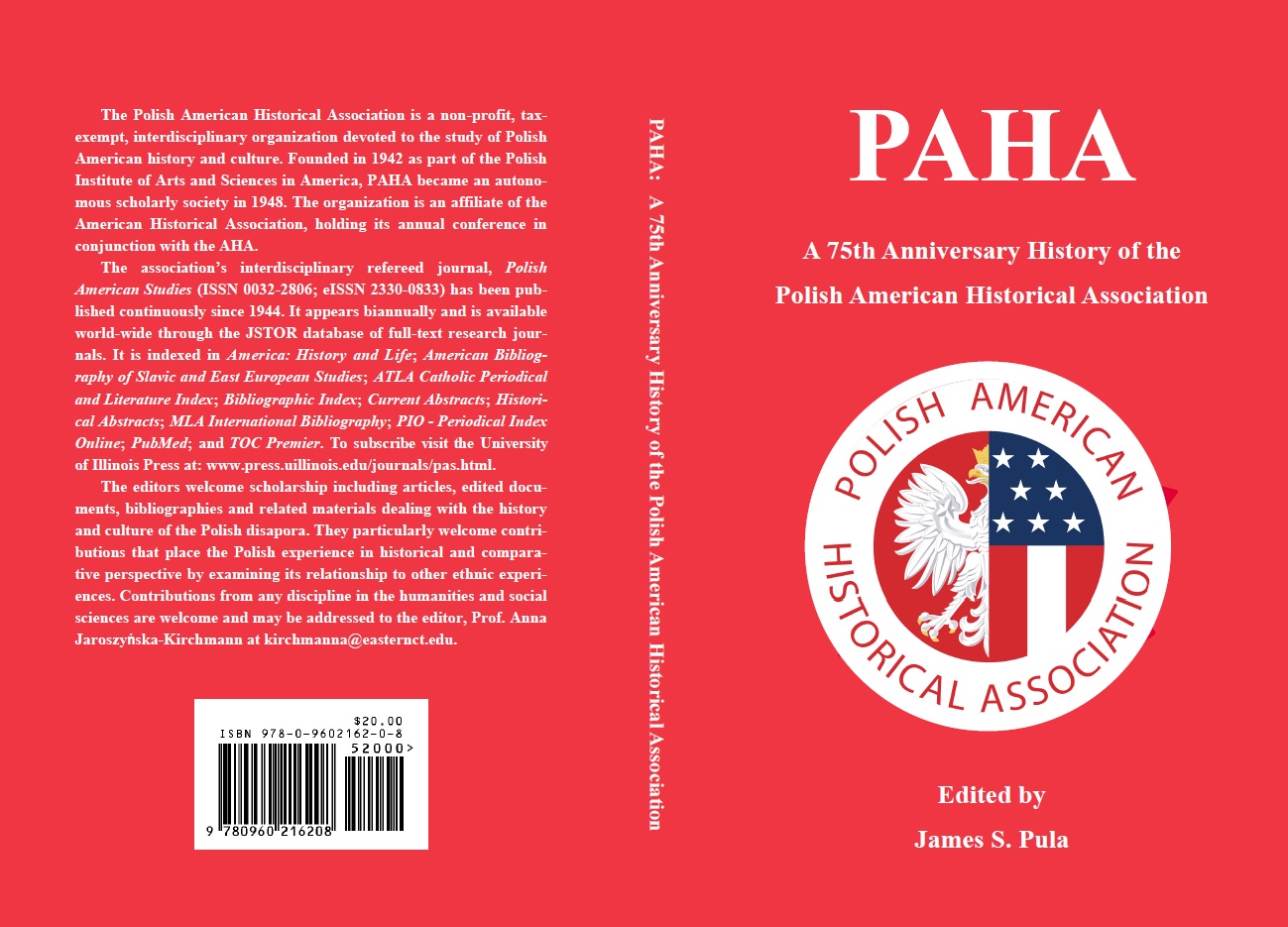
To find out more about PAHA's history and achievements, please have a look at our Anniverary Book, edited by James S. Pula and available here [click].