Showing posts with label Polish American history. Show all posts

Friday, March 13, 2020

Send Family Memoirs and Letters to Polish Heritage Collection in Connecticut


POLISH AMERICAN HISTORICAL ASSOCIATION MEMOIRS PROJECT

Polish Migrant Memoirs and Letters: Documenting the World War II Diaspora

With the outbreak of World War II on September 1, 1939, the Polish nation faced an overwhelming experience of displacement and dislocation. As a consequence, close to six million Poles found themselves outside Poland's new borders; at the end of the war, nearly 500,000 Poles remained in exile, scattered over many countries on all continents. About 140,000 Polish immigrants -- political exiles, civilian refugees, displaced persons, former soldiers, slave laborers, and prisoners of concentration camps -- settled permanently in the United States.

With this war generation passing, it becomes ever more urgent to tell their story, to preserve the record of their experience and make it available to the next generations. The Polish American Historical Association (PAHA) is a professional organization international in scope and in existence since 1943, whose goal is scholarly research and promotion of the study of the history and culture of the Polish American diaspora.


PAHA is alarmed by the disappearance of documentation on the history of the World War II and immediate postwar wave of Polish migration to the United States. Recognizing the contributions of Polish migrants to Polish American as well as American history, PAHA appeals to the members of the exile generation, their families, and their organizations to deposit their existing records in archival and research institutions.

To facilitate the preservation effort, the Polish American Historical Association is inaugurating a new project titled “Polish Migrant Memoirs and Letters: Documenting the World War II Diaspora.” In collaboration with the Central Connecticut State University’s Library (Polish Heritage Collection) and Stanislaus A. Blejwas Chair in Polish and Polish American History, the Polish American Librarians’ Association, PAHA is announcing search in the United States for the following documents among members of the WWII Diaspora in North America: memoirs (published and unpublished); diaries; letters; interviews and photos. The war and immediate post-war period is the main focus of the search, however, we are interested in the entire life of these migrants, not just the war years.

The documents, along with the deed of gift,  should be sent to:

Central Connecticut State University
Elihu Burritt Library
Attention: Ewa Wolynska, Head, Special Collections
PAHA Memoirs Project
1615 Stanley St.
New Britain, CT 06050

If you are interested in donating to this project and are seeking more information please contact:

Dr. Ewa Barczyk (ewa@uwm.edu 414-412-6456).

You can find the Deed on Gift on our website:
https://polishamericanstudies.org/text/180/memoirs-.html


Monday, May 6, 2019

Prof. Dominic Pacyga - Vice-Marshall in Chicago's 127th Constitution Day Parade

Dr. Pacyga among officials of  the Parade. Students present the banner
with the motto of the 2019 parade. Photo by Andrew Mikolajczyk. Used by Permission

Dr. Dominic Pacyga, a highly respected historian of Polonia and an expert on the history of Chicago served as Vice-Marshall in the 2019 Constitution Day Parade in Chicago.  He commented: "Being Vice- Marshall of the Polish Constitution Day Parade in Chicago was one of the high points of my professional life. I was surprised and honored to be nominated by the Dziennik Związkowy and grateful for their endorsement of my work. The parade was wonderful. It was a delight to see so many young people and children involved. I was especially happy to see the widespread support of Polonia for the event. It proves the staying power of Polskość and that the Chicago area’s Polonia remains a vital force in the social, economic, cultural, and political life of the city and suburbs."

Dominic Pacyga getting ready for the parade. Photo by George Woznicka

Dominic A. Pacyga is Professor Emeritus of the Columbia College in Chicago. For three decades, he taught  in the Liberal Education Department at the college. He earned his Ph.D. in history from the University of Illinois at Chicago in 1981 and has wide ranging interests in urban development, labor history, immigration, and racial and ethnic relations.   He worked with museums including the Chicago Historical Society, the Museum of Science and Industry, and the Field Museum in Chicago on a variety of public history projects. Pacyga has also worked with numerous neighborhood organizations as well as ethnic, labor, and fraternal groups to preserve and exhibit their histories. Pacyga acted as guest curator of a major exhibit, "The Chicago Bungalow" at the Chicago Architecture Foundation, and co-edited The Chicago Bungalow (Arcadia Press 2001), a companion volume to the exhibit.

St. Maksymilian Kolbe Polish School and youth in Lowicz costumes 
at the 2019 Parade. Photo by Andrew Mikolajczyk

Dr. Pacyga won the Oscar Halecki Award from the Polish American Historical Association for his book, Polish Immigrants and Industrial Chicago (1991) and the Catholic Book Award for Chicago: City of Neighborhoods (1986). Dr. Pacyga served on PAHA Board in 2016-2018. During the 75th Anniversary  Conference of PAHA (at Loyola University Chicago, September 2018), Dr. Pacyga took the participants on a tour of Polish Chicago; and a summary was posted on this blog: http://pahanews.blogspot.com/2018/10/tours-of-chicago-with-dominic-pacyga.html


The Parade in 1999. Photo by Belissarius. Wikimedia Commons.

The Polish Constitution Day Parade in Chicago was held for the first time in 1892 in Humboldt Park, and after World War II it was moved to downtown, currently being held in Grant Park, from Buckingham Fountain to the bridge.  The event honors Poland's May 3rd Constitution, the first democratic constitution of Europe, adopted by the Polish Seym in 1791, after four years of debating. It is the second constitution of its kind, following the Constitution of the United States Constitution.

Women in Highlander Costumes. Photo by Andrew Mikolajczyk


The 2019 Parade Marshall was Józef Cikowski, president of Polish Highlanders Alliance of North America, an organization gathering former residents of the Tatra Mountains and their foothills, who emigrated to Chicago in large numbers mostly prior to World War I. The election of the Marshall was held in March, with interviews of the top candidates w ho presented their achievements on behalf of Polonia. http://dziennikzwiazkowy.com/polonia/jozef-cikowski-marszalkiem-parady-3-maja/

St. Urszula Ledochowska Polish School. Photo by Andrew Mikolajczyk

More than 100 Polonia organizations participated in the parade, including schools, culture clubs, Polish student clubs, Polish scouts (Harcerstwo), businesses, and fraternal and social organizations. The parade was watched by about 200,000 viewers. All Polish language schools their students to the parade, and about 10,000 students participated in the parade, marching with their teachers, carrying flags and banners.

 Photo by Andrew Mikolajczyk


Photo by Andrew Mikolajczyk

Casimir Pulaski Polish School. Photo by Andrew Mikolajczyk

Polish American Student Alliance from Northwestern University.
Photo by Andrew Mikolajczyk

Photo by Andrew Mikolajczyk

Friday, January 25, 2019

Remarks of PAHA's New President Anna Muller at 76th Annual Meeting in Chicago, January 2019


Prof. Anna Muller, University of Michigan, Dearborn, was elected to lead the organization and took over the helm at the PAHA Board Meeting in Chicago, on January 6, 2019.  In her role as First Vice President she was the Chair of the Program Committee of the 76th Annual Meeting of PAHA, held in Chicago on January 3-6, 2019. Her remarks are reproduced below.


OPENING REMARKS AT THE 76TH ANNUAL MEETING 
OF PAHA IN CHICAGO (1/3/2019)

Dear Friends and Colleagues,

It is my great pleasure to welcome you to the 76th annual Polish American Historical Association conference. This is a special one – the first one after our big 75th anniversary that we celebrated just five months ago, which was also in Chicago. So, here we are again – in beautiful and vibrant Chicago – a city that has a very special place in the heart of the Polish-American community. To many of us, Chicago feels like home – a place that resonates with important histories and memories for both Poles and Polish-Americans. So here we are again – making friends, thinking of new projects, drawing stimulating observations from history, and ultimately making history again. This is the first year of the next 75 years of PAHA’s life, hopefully as creative as the first 75 years. The theme for this year’s conference is “Loyalties.”

Yes, we mirror the AHA conference theme that defines loyalty as a form of human attachment that functions on multiple levels – social, political, group, and individual. I find this topic especially constructive for us – Polish American historians – because in our work, we continuously reflect on the intricacies and richness of individual and group identities, the various forms they take, the conflicts and negotiations they imply, and creative (and less creative) solutions the struggle around them provoke. I am convinced that personally and professionally, this theme has a special meaning for us and the ways we imagine or construct our own identities as well as the identities of the individuals or groups we study.
 
This year, like previous years, PAHA enjoys a significant interest from European scholars. We compiled in total 9 panels comprising twenty-nine presentations dealing with Polish and Polish-American history. Unfortunately, every year January is a challenging month to travel which means that some of the presenters had to cancel their participation, resulting in a few panels having only two presenters. However, I am pretty sure we can deal with the extra time by filling it with thought-provoking discussions.

So, let me wrap up by wishing us all interesting presentations, challenging questions, and stimulating discussions. I hope that by the end of Saturday we will feel personally and professionally enriched and satisfied. On Saturday night, we will close this year’s conference with an award’s banquet at the Chopin Theatre, a place that is very important for the local community and which I hope will welcome you with an exceptional and festive atmosphere appropriate for the end of two days of heavy work and the initiation of another calendar year of PAHA’s work.


CLOSING REMARKS AT THE AWARDS CEREMONY 
AT THE CHOPIN THEATRE IN CHICAGO (1/5/2019)

Dear Friends and Colleagues,

Serving as PAHA President is a great honor and responsibility. Many of you may not know me, as I am a relatively recent addition to PAHA. I will be very honest and say that when I was asked to become the first v-ce president over two years ago, it did not quite occur to me that the 1st v-ce president most likely at some point would have to become president. It was too late to back out when I realized what is in store for me.

For the last couple of years, I have been learning from you: from the effortless elegance and effectiveness of Grażyna Kozaczka, from Ania’s unbeatable enthusiasm and energy. I cannot name everybody here, but Ania Jaroszyńska- Kirchman, Mary Erdman, Pien Versteegh, Jim Pula, Neal Pease, and of course Maja Trochimczyk were models of unmatched dedication to the Polish-American community, the organization, and to former leaders. But in addition to learning to respect your individual efforts, for the last years of being close to you, my appreciation was growing for your skills of working together – negotiating, coming up with new projects, finding means and times to accomplish your goals.

I kept learning that PAHA is much more than an organization – it is a group of friends, an intellectual and emotional community that is driven by a mutual respect and devotion to the past, but also a sense of civic duty that links the past with the present. Becoming the president for PAHA for the next two years, I cannot promise the deep knowledge of the organization that Ania and Grażyna have (and I know most of you have as well).

From this point of view, it seems that as long as I don’t ruin everything, the organization will be fine. It is strong and more importantly it has some seriously committed members. But to be serious, I appreciate your trust, feel very honored, and I hope to continue the path that Ania initiated – by making sure that the organization maintains a strong position in academic organizations and responds to the challenges of the 21st century, while building bridges between generations and continuously reflecting on who we are, how we are changing and where we are going.


I would like to say thank you from the bottom of my heart for your trust. I am honored to be granted the responsibility of running the PAHA for the next two years. I would like to say thank you to the previous PAHA board for their service and commitment. At the same time, I would like to welcome new PAHA board as well as thank you for your willingness to serve our organization. Ahead of us is another busy year full of work on various projects that we have initiated within the last couple of years. I am very grateful for your willingness to serve the organization and I am sure together we can achieve a lot. Thank you.

Anna Muller
President of Polish American Historical Association


Members of PAHA Board during the meeting in Chicago, January 2019
L to R, standing: James Pula, Robert Synakowski, Dominic Pacyga, Bozena Nowicka McLees, Neal Pease, and Anna Jaroszynska Kirchmann. Seated L to R: Maja Trochimczyk, Anna Mazurkiewicz, Pien Versteegh, Anna Muller.

Tuesday, September 18, 2018

Program of PAHA's 76th Annual Meeting in Chicago, Il, January 3-6, 2019


76th Annual Meeting of Polish American Historical Association

All Sessions will be at Hilton Chicago, 720 S. Michigan Ave, Chicago, Illinois, 60605. PAHA's meeting is held in association with the 133rd Annual Meeting of the American Historical Association.

To get to the hotel from the O'Hare Airport take the Blue Line train to Jackson stop and walk 0.6 miles southeast. To get to the hotel from  Midway Airport take the Orange Line train to the Roosevelt stop and walk 0.5 miles north to 720 S. Michigan.

REGISTRATION for PAHA's 76th  Annual Meeting in Chicago is REQUIRED. The attendance is FREE - there is NO Registration Fee to attend the meeting. However, there  is a FEE of $45 per person for the Awards Banquet which will take place at the Chopin Theatre, 1543 W Division St, Chicago, IL 60642. The awardees attend for free. The Banquet Fee may be paid using PayPal: links are on the website: http://polishamericanstudies.org/text/19/registration.html

This program may be dowloaded in PDF Format from PAHA Website.

Chicago and Lake Michigan, Photo by Maja Trochimczyk

Session 1: Building the Polish Diaspora: Polish Communities Abroad
Thursday, January 3, 2019: 1:30 PM-3:00 PM
Hilton Chicago, Conference Room 4K
Chair: Pien Versteegh, Avans University of Applied Sciences

Papers:
  • From Popular to Personal: Polish-American Influence at the 1919 Paris Peace Conference - Denis Clark, University of Oxford
  • Building the Diaspora: Circulations of Ideas and Practices between French and American Polonia during the Cold War - Florence Vychytil-Baudoux, Centre Français de Recherce en Sciences Sociales
  • Jones Island Milwaukee Kaszube Fishermen and Loyalty Bonds to St. Stanislaus Church  - Ann Gurnack, University of Wisconsin-Parkside
  •  Comment: The Audience
                                            PAHA Board Meeting in Chicago, Photo by Maja Trochimczyk


PAHA Board Meeting Part 1

Thursday, January 3, 2019: 3:30 PM-5:00 PM
Hilton Chicago, Conference Room 4L
Presider: Anna Mazurkiewicz, University of Gdańsk

 Lake Michigan, Photo by Maja Trochimczyk

Session 2: Loyalty to a Patriotic Ideal? And If So, Which? Memory Politics and Cultural Politics in Post-World War II Poland

Friday, January 4, 2019: 8:30 AM-10:00 AM
Hilton Chicago, Conference Room 4K
Chair: Michal Janusz Wilczewski, University of Illinois at Chicago

Papers:
  • “Her Soul Was That of a Heroine”: Polish Warrior Women in 19th-Century American Literature - Jill Noel Walker Gonzalez, La Sierra University
  • Satiric Rogues: Satire between Protest and Team Building in Stalinist Poland - Elizabeth Wenger, independent scholar
  • Between Gender Blindness and Nationalist Herstory: Writing Women's History in Times of Illiberal Revisionism in Poland - Weronika Grzebalska, Polish Academy of Sciences
  • Active National Forgetting and Sexual Violence in Poland during and after the Second World  War as Seen through the Works of Andrzej Wajda - Meghann T. Pytka, Northwestern University
  • Comment: The Audience
Sculpture by Magdalena Abakanowicz in Chicago, Photo by Maja Trochimczyk


Session 3: Lifelong Affection: Americans in East Central Europe from World War I to the End of the Cold War

Friday, January 4, 2019: 10:30 AM-12:00 PM
Hilton Chicago, Conference Room 4K
Chair: Anna Muller, University of Michigan–Dearborn

Papers:
  • William J. Tonesk: Polish-American Quests in East Central Europe, 1920s–40s - Anna Mazurkiewicz, University of Gdańsk
  • Hugh S. Gibson: An American Diplomat in Warsaw, 1919–24 - Vivian Reed, Western Oregon University
  • Gene Deitch: An American Illustrator in Prague, 1959 to the Present - Francis D. Raška, Charles University
  • Comment: The Audience
 Lake Michigan, Photo by Maja Trochimczyk


Session 4: Conflicted Loyalties and/or Pragmatism

Friday, January 4, 2019: 1:30 PM-3:00 PM
Hilton Chicago, Conference Room 4K
Chair: Anna D. Jaroszyńska-Kirchmann, Eastern Connecticut State University

Papers:
  • Conflicting Loyalties: Sexual and Ethnic Identity among Polish Immigrant Gay Men in Chicago - Hubert Izienicki, Purdue University Northwest
  • Loyalty and Pragmatism: US Naturalization Rates of New Polish Immigrants - Mary Patrice Erdmans, Case Western Reserve University
  • Comment: The Audience
Chicago and Lake Michigan, Photo by Maja Trochimczyk


Session 5: Polish Soldiers' Loyalty in Transnational Context

Friday, January 4, 2019: 3:30 PM-5:00 PM
Hilton Chicago, Conference Room 4K
Chair: James Pula, Purdue University Northwest

Papers:
  • Between Civilization and Barbarians: Loyalty of Slavic and Roman Soldiers in the Second Half of the 6th Century - Łukasz Różycki, Adam Mickiewicz University
  • False Stones or Diamonds in the Rough? Polish and American Mercenary Officers in the Egyptian Army, 1833–83 - John P. Dunn, Valdosta State University
  • Negotiated Loyalties: Poles and the Polish Cause on the Battlefields of the American Civil War - Piotr Derengowski, University of Gdańsk
  • Loyalty to Your Country, to Your Men, or to Oneself? The Question of Surrender in the Polish Military during World War II - Jan Szkudliński, Gdynia City Museum
  • Comment: The Audience

South Chicago, Photo by Maja Trochimczyk

Session 6: Reconstructions, Processes, and (Invented) Traditions

Saturday, January 5, 2019: 8:30 AM-10:00 AM
Hilton Chicago, Conference Room 4K
Chair: Mary Patrice Erdmans, Case Western Reserve University

Papers:
  • Kosloski’s Kashub Commodities: Tradition, Scarcity, and Why We Value Wilno Furniture - Joshua Blank, independent scholar
  • Staying Polish? Changing Ethnic Sentiments of Polish Migrants in the United States - Pien Versteegh, Avans University of Applied Sciences
  • The New Ethnicity Movement and Polish Americans: It's Coming, Going, Significance, and Consequences - Donald Pienkos, University of Wisconsin–Milwaukee
  • Comment: The Audience
St. Stanislaw Kostka Church with Girls in Gorale Costume


Session 7: Different Faces of Polishness

Saturday, January 5, 2019: 10:30 AM-12:00 PM
Hilton Chicago, Conference Room 4K
Chair: Anna Mazurkiewicz, University of Gdańsk

Papers:
  • The Warsaw Positivists and the Racial Redefinition of Polishness in the Second Half of the 19th Century - Marta Cieslak, University of Arkansas at Little Rock
  • Social Theory of the Peasant Migrant and the Problem of Universalism in Polish History - Kathleen Wroblewski, University of Michigan
  • Polonizing an Anglo Community - James Pula, Purdue University Northwest
  • Comment: The Audience
South Chicago street,  Photo by Maja Trochimczyk


Session 8: American Ethnics in the Post-World War II Decades

Saturday, January 5, 2019: 1:30 PM-3:00 PM
Hilton Chicago, Conference Room 4K
Chair: David A. Gerber, State University of New York at Buffalo

Papers:
  • Urban Renewal and the Response of American Ethnic Groups, 1949–74 - Anna D. Jaroszyńska-Kirchmann, Eastern Connecticut State University
  • Racial Reason and Post-World War II Italian American Assimilation in Boston’s North End - James Pasto, Boston University 
  • Italian Americans and the Limits of White Ethnic Liberalism in Postwar Immigration Reform Campaigns - Danielle Battisti, University of Nebraska at Omaha
  • Individual Effort, Not Quotas: American Jews against Affirmative Action in the 1970s and 1980s - Eric Morgenson, State University of New York, University at Albany
  • Comment: David A. Gerber, State University of New York at Buffalo
Our Lady of Perpetual Help Church in South Chicago

Session 9: War, Displacement, and Polish Communities

Saturday, January 5, 2019: 3:30 PM-5:00 PM
Hilton Chicago, Conference Room 4K
Chair: Angela Pienkos, Polish Center of Wisconsin

Papers:
  • "For Us Americans of Polish Descent, War Broke out on September 1st, 1939": The Divided Loyalties of the Sienkiewicz Youth Circle - Andrew Kless, University of Rochester
  • Defining Poland through Music: American Musical Celebrations of the Centennial of Poland’s Regained Independence - Maja Trochimczyk, Moonrise Press, Los Angeles
  • The Foundations of the Polish Diaspora in Exile after World War II: Cultural Identity and Loyalty of the Polish Emigres in Resettlement - Agata Błaszczyk, Polish University Abroad
  • Comment: The Audience

Chicago street, photo by Maja Trochimczyk

Annual  PAHA Awards Banquet 

Saturday, January 5, 2019, at 7 p.m.
Chopin Theater, 1543 W Division St, Chicago, IL 60642
Tickets are $45 per person, the awardees attend for free.

To reserve your seat for the Awards Banquet, register for the conference and pay the Awards Banquet Fee, please visit our website:
http://polishamericanstudies.org/text/19/registration.html


PAHA Board Meeting Part 2

Sunday, January 6, 2019: 9:00 AM-10:30 AM
Hilton Chicago, Conference Room 4K
Presider: Anna Mazurkiewicz, University of Gdańsk


Friday, August 3, 2018

PAHA's 75th Anniversary Conference at Loyola University Chicago, September 7-9, 2018


On September 7-9, 2018, PAHA will be celebrating its 75th Anniversary. The Association is planning a three-day event to take place at Loyola University in Chicago.  The director of the Polish Studies Program at Loyola, Bozena Nowicki McLees, will serve as host to PAHA and its guests at the conference venue located right on the waterfront of Lake Michigan. In addition to Loyola University Chicago, the Polish Academy of Arts and Sciences (Kraków, Poland) is a proud partner to this event - which is partially funded by the Senate of the Republic of Poland.  

The three-day conference will begin with the keynote address by Prof. John Bukowczyk of Wayne State University, “PAHA within the field of United States’ ethnic history - past, present and future.”  The Friday program will include academic sessions related to PAHA’s contribution to the fields of migration and ethnic studies (including the association’s journal, Polish American Studies), the association’s current research as well as community outreach projects. You will hear from some of the most prominent PAHA's scholars - of all generations. 

The Saturday sessions will be dedicated to Polish American issues and will include a local Polonia roundtable.  Prof. Dominic Pacyga, the key PAHA expert on the history of Chicago, will chair a session on Polish American history in Museums - both in the USA and in Poland. There will be plenty of opportunities for PAHA scholars to meet, interact and plan future programs with members of American Polonia. The conference will be rounded up with a Chicago Tour, Loyola University special collection tour, and a Saturday night concert at Mundelein Center, Loyola University  Chicago. 

ORGANIZERS: The 75th Anniversary Conference at Loyola University Chicago is partially funded by the Senate of the Republic of Poland. The organizers include: Polish American Historical Association; Polish Studies Program at Loyola University Chicago; Polish Academy of Arts and Sciences (PAU); Institute of American Studies and Polish Diaspora, Faculty of International and Political Studies at the Jagiellonian University; Committee for Migration Studies of the Polish Academy of Sciences (PAN).

All conference events will take on the campus of Loyola University of Chicago. Here's the campus map.


REGISTRATION is free, but you need to register for the whole conference or specific sessions:
http://polishamericanstudies.org/files/public/Registration75YearsPAHA.pdf

PROGRAM: The PDF version of our program brochure is available on the PAHA website: 
http://polishamericanstudies.org/files/public/PAHA75ProgramBrochure.pdf


PROGRAM

FRIDAY, SEPTEMBER 7, 2018
McCormick Lounge in Coffey Hall 1000 W. Sheridan Road, Loyola University Chicago

9:00–9:35    WELCOME

9:40–10:15 KEYNOTE ADDRESS
John Bukowczyk, PAHA within the field of United States’ ethnic history - past, present and future


10:30–12:30   QUO VADIS POLISH AMERICAN STUDIES:
THE PAHA JOURNAL AS A REFLECTION OF THE SCHOLARLY FIELD
McCormick Lounge in Coffey Hall 1000 W. Sheridan Road, Loyola University Chicago

Chair: Anna Jaroszyńska-Kirchmann
- A Brief History of PAS – James S. Pula
- Labor and Working Class – Dominic A. Pacyga
- Polonia’s Organizations – Donald Pienkos
- Gender and Family – Mary P. Erdmans
- Literature – Grażyna Kozaczka
- Study of American Polonia and Scholars in Poland – Adam Walaszek

12:30–13:50 LUNCH BREAK

14:00–15:20 YOUNG SCHOLARS & NEW TOPICS FORUM
McCormick Lounge in Coffey Hall 1000 W. Sheridan Road, Loyola University Chicago
Chair: Dorota Praszałowicz

15:30–16:50 PAHA’S NEW PROJECTS
McCormick Lounge in Coffey Hall 1000 W. Sheridan Road, Loyola University Chicago
Chair:  Neal Pease

- PAHA’s communication media, challenges and opportunities of
the digital age – Maja Trochimczyk & Stephen Leahy
- Adjusting to the New Reality: Good Management Practices in Academia – Pien Versteegh
- PAHA and Polish American Community – Joint Projects: Polish American Travel Guide; Memoirs Project; Objects that Speak; Teaching Resources – panel discussion (Anna Jaroszyńska-Kirchmann, Ewa Barczyk, Anna Muller, Anna Mazurkiewicz)

18:00 BANQUET AT THE POLISH CONSULATE, CHICAGO
(Prior registration required. Polish Consulate 1530 N. Lake Shore Drive, Chicago.


SATURDAY, SEPTEMBER 8, 2018

9:00–11:00    POLISH AMERICAN HISTORY IN MUSEUMS
McCormick Lounge in Coffey Hall 1000 W. Sheridan Road, Loyola University Chicago
Chair: Dominic A. Pacyga; Discussant: Anna Muller

- The Polish Museum of America, Chicago –Małgorzata Kot
- Polish History Museum, Warsaw – Anna Piekarska
- Chicago History Museum, Chicago – John Russick
- Emigration Museum, Gdynia – Sebastian Tyrakowski
- Józef Piłsudski Institute of America, New York – Iwona Korga

11:15–12:45  CONCURRENT EVENTS

a) LOYOLA ARCHIVE TOUR with Nancy Freeman
Loyola Archives Tour starts at 11:15 at McCormick Lounge in Coffey Hall 1000 W. Sheridan Road


b) FILM SCREENING  of The Fourth Partition: Chicago by Adrian Prawica
Damen Student Center Cinema on ground floor, Loyola University Chicago

13:00–14:00  LUNCH BREAK

14:00–15:00  PAHA 2018 HALECKI BOOK PRIZE 
McCormick Lounge in Coffey Hall 1000 W. Sheridan Road, Loyola University Chicago
Joanna Wojdon, White and Red Umbrella – presentation of the Haiman Medal and discussion of the prize-winning book 

15:00–17:00 POLONIA ROUNDTABLE ON THE ADVANCEMENT OF POLISH AND POLISH AMERICAN STUDIES 
McCormick Lounge in Coffey Hall 1000 W. Sheridan Road, Loyola University Chicago
Chair: Bożena Nowicka McLees. Discussants:  Members of Chicago & Great Lakes Polish-American social and cultural organizations. 

17:30  RECEPTION FOR  REGISTERED PARTICIPANTS
Crown Center Lobby, Loyola University Chicago

20:00–21:30  CONCERT of LOYOLA CHAMBER SINGERS AND  HANSUNG KANG at Mundelein Center, Skowronski Hall, 2nd floor, Loyola University Chicago. 


SUNDAY, SEPTEMBER 9, 2018

9:30–13:00 SPECIAL PROGRAM FOR REGISTERED PARTICIPANTS 
Tour of North Side of Chicago with Victoria Granacki 
Bus tours pick-up and drop off at the Hampton Inn.

8:30–12:30 PAHA BOARD MEETING–PAHA Council and Officers only,  Crown Center 200 East
12:30–13:30 Working Lunch for PAHA Council and Officers only,  Crown Center 200 East
13:30–16:30 Bus Tour of South Side of Chicago for PAHA Board members with Dominic A. Pacyga


PROGRAM COMMITTEE: Anna Mazurkiewicz, PAHA President, University of Gdańsk; Zygmunt Kolenda, President on behalf of PAU; Bożena Nowicka McLees, Chair of the Polish Studies Program, Loyola University Chicago. Members: Mary P. Erdmans, Case Western Reserve University; Neal Pease, University of Wisconsin-Milwaukee; Dominic Pacyga, Columbia College Chicago; Dorota Praszałowicz, PAN Committee for Migration Studies; James Pula, Purdue University Northwestern, Adam Walaszek, Jagiellonian University.
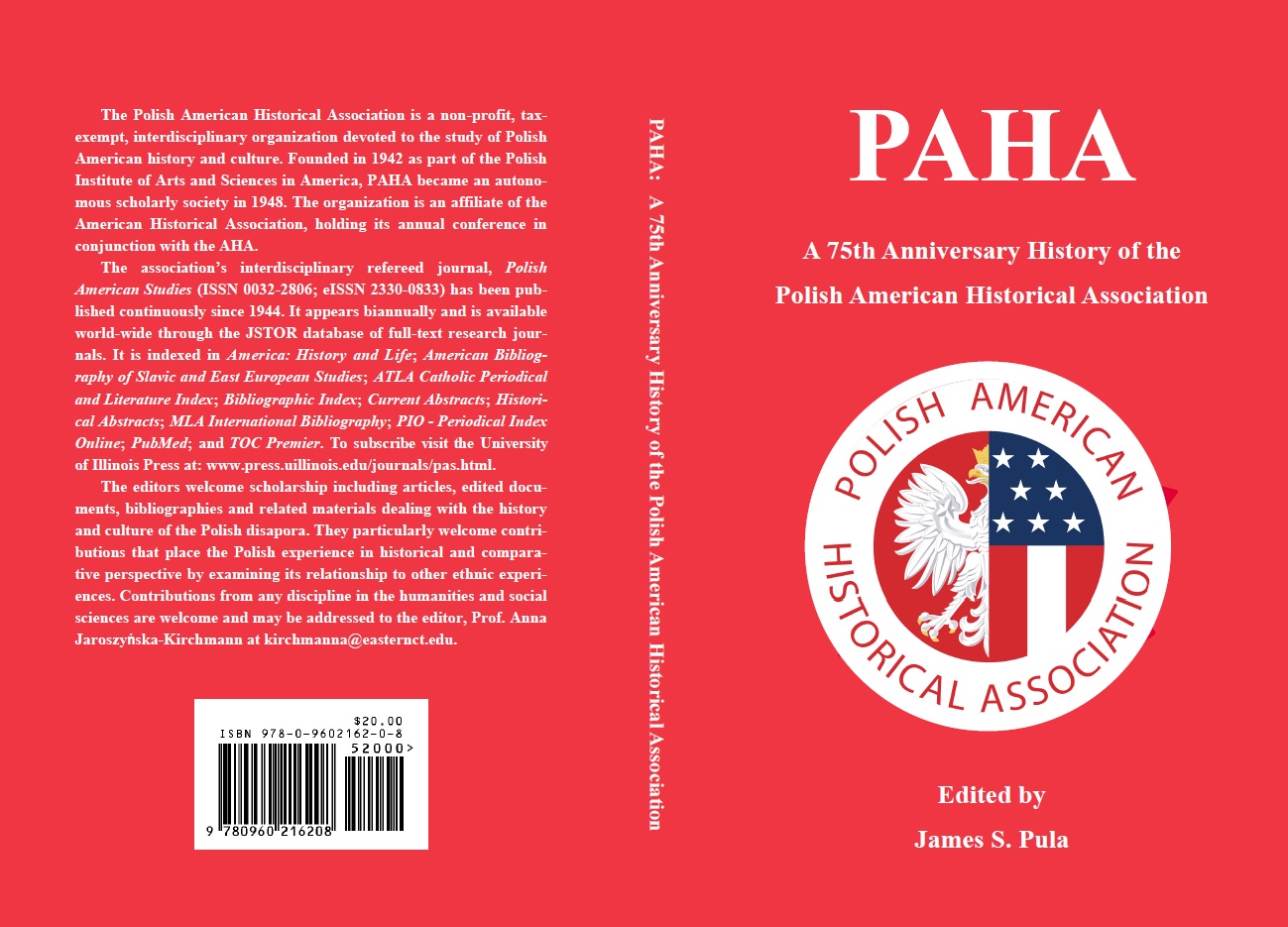
To find out more about PAHA's history and achievements, please have a look at our Anniverary Book, edited by James S. Pula and available here [click]. 

Monday, October 10, 2016

October Events - King Jagiello in Central Park and Latin America in Gdynia

Unveiling of King Jagiełło Statue in NY Central Park, October 29-30, 2016
   

On 29 – 30 October 2016, The King Jagiełło Monument Working Group is organizing The King Jagiełło Monument Unveiling Ceremony in Central Park and a Symposium entitled: “King Jagiełło in New York 1939-2016”, in Polish Consulate in New York. The King Jagiełło Monument Working Group was established by: Józef Piłsudski Institute, Polish American Congress – Long Island Division, Nowodworski Foundation, Association Polonia Technica, Consulate of the Republic of Poland in New York, St. Stanislaus B&M Parish in Manhattan, Prof. Krzysztof Wodiczko of Harvard University, and historian Krystyna Piórkowska.

The statue of King Jagiełło, was originally installed in the Polish Pavilion during the World’s Fair in 1939, and remains in New York City at the location in Central Park since 1945 till now. Currently, overall conservation work is performed, which is scheduled to be completed by mid-October. The Working Group promotes the legacy of King Władysław Jagiełło a symbol of Polish Victory for centuries by organizing symposium in Polish Consulate and monument unveiling ceremony in Central Park.  Their goal is to address this historic topic to the US Polonia and American historic community. The Symposium is scheduled on October 29th (Saturday) between 10:00 am and 5:30pm and will consist of four panels:  Stanisław Kazimierz Ostrowski and Polish Art Deco /  King Jagiełło and his Concept of a Unified Europe / Historical Sculptures in the Public Domain / Conservation work on the King Jagiełło Statue/ Polish Conservators in the World. All the proceedings will be in English. Registration is required.

On October 30, 2016 (Sunday) the unveiling ceremony of the King Władysław Jagiełło Monument is scheduled for Central Park, New York. The ceremony is planned as follows: Around 80 people will stay at the monument circle, at walkway and square in front of Turtle Pond. There will a banner informing about the event, together with another banner depicting the Battle of Grunwald as a backdrop for children’s performance. The schedule of the event: 1:00 pm – Welcome address, Consul of Republic of Poland and Jerzy Lesniak, President Nowodworski Fundation; 1:00 pm – A brief historical background and history of the monument and the history of King Jagiełło Swords – Wojciech Budzynski; 1:10 pm– Symbolic ceremony of King Jagiełło Monument unveiling; 1:20 pm – Speech by Marie R. Warsh, the Central Park Conservancy; 1:30 pm – Dedication of the Monument by Father Tadeusz Lizińczyk; 1:40 pm – “Battle of Grunwald” presentation by a school theater troupe (approx. 10 students) at the monument plinth, with choir; 2:30 pm – Placing flowers at the base of the monument and a Photo-op; 2:40 pm- Ballads sung with guitar at the monument.

   Poles and Polish Diaspora in Latin America, October 27-28, 2016   

The Emigration Museum in Gdynia presents a two-day international conference on Poles and Polish Diaspora in Latin America: Past and Present. The following papers will be presented. 
October 27: Opening Session with papers by 
  • Adam Walaszek (Emigration from Poland and Portugal: two cases. Are they different? 1500-1939); 
  • Andrzej Chodubski (Cultural and civilisation image of Poles in Latin America); 
  • Renata Siuda Ambroziak (The problem of leadership among the Brazilian Polish diaspora), and 
  • Rafał Raczyński (Latin American Polish diaspora at the Emigration Museum in Gdynia). 
The second session on historical aspects of Polish presence in Latin America includes papers by: 
  • Jerzy Mazurek (Polish colonial and settlement projects in Latin American countries in the interwar period); 
  • Thaís Janaina Wenczenovicz (History and historiography: interpretative views on the Polish immigration in the south of Brazil); 
  • Claudia Stefanetti Kojrowicz (When the Allies Closed the Doors, General Perón Accepted Two Thousand Italian-Polish Marriages in the Post-War Era); 
  • Teresa Sońta-Jaroszewicz (Wandering life of the refugees of Polish descent from Marseille to South America during World War II); 
  • Aleksandra Pajek (Brasil in the imagina-tion – hopes and fears of Polish refugees right before leaving Europe during World War II) and 
  • Karolina Baraniak (Polish diaspora in Chile). 
A session on the Polish community in the State of Parana, features papers by: 
  • Mariléia Gärtner and Luciane Trennephol da Costa (The presence of Slavic culture in the interior of Parana state in Brazil), 
  • Lenny A. Ureña Valerio (Creating a Polish nation from colonies: analysis of the settling colonialism and creating Polish colonies in Parana), 
  • Rodrigo Augusto (Sustainable territorial development with the cultural identity in the Parana state), 
  • Ancelmo Schörner (Polish immigration in Palmeiras (PR): the colony of Santa Barbara in the memories of Helena Orchanhenka), 
  • Nelsi Antonia Pabis (Education and culture: the Polish immigrants' schools in the south of Parana), 
  • Elisabeth Sylvia Janik (A story of success: Sebastian Woś Saporski and Polish immigration to Curitiba), and 
  • Sonia Eliane Niewiadomski (Today's panorama of the Polish-Brazilian community in the southern and central parts of Parana). 
The evening session is dedicated to Latin American Polish diaspora as a research area, with papers by: 
  • Maria Skoczek and  Bogumiła Lisocka-Jaegermann (Poles in Latin American research centres and universities),  
  • Krzysztof Smolana (About new sources in the history of the Latino American Polish Diaspora), 
  • Joanna Łuba with Dominik Czapigo ("Developing sources" – presentation of the documentation project by the KARTA Centre and the Ignacy Domeyko Polish Library in Argentina), 
  • Michalina Petelska (From Guatemala to Gdynia) .
On October 28th the morning session is dedicated to Poles' contribution to the social and cultural development of the Latin American countries, with papers by: 
  • Henryk Siewierski ("Doutor Magico": Piotr Ludwik Napoleon Czerniewicz and his position in the history of medicine and Brazilian culture); 
  • Katarzyna Krzywicka (Missionary activity of the Congregation of Saint Michael the Archangel in Latin America); 
  • Zdzisław Malczewski (Polish missionaries in Brazil); Aleksandra Pluta (Polish artists' contribution for the cultural life of Brazil and Chile); 
  • Rhuan Targino Zaleski Trindade (Polish scientist among settlers: Czesław Bieżanko and Poles in the south of Brazil); 
  • Beata Bereza (Ludwik Margules – triumph of the theatrical style); Justyna Łapaj (Polish diaspora and Poles in selected countries of Latin America).  
The second session of the day is dedicated to the literary aspects of Polish presence in Latin America, with papers by: 
  • Silvia Dapía (New subjectivity after World War II in The Marriage by Witold Gombrowicz);
  • Elżbieta Budakowska (Polish ethnic literature in Brazil in the sociological perspective); 
  • Anna Jamrozek-Sowa (Successful immigrants. Protagonists of Aleksandra Pluta's tales); 
  • Kalina Sobierajska (Female traveller, emigrant and cosmopolitan - the portrait of Maria Bochdan- iedenthal). 
The afternoon session is dedicated to the language and identity of the Polish communities, with papers by 
  • Władysław T. Miodunka (Polish language in the perspective of Polish-Spanish and Polish-Portuguese bilingualism); 
  • Izabela Stąpor (Szakier, fiżon i trokować – on the lexis of Polishsettlers in Parana); 
  • Anna Kaganiec-Kamieńska (Polish language and identity in Argentinian Polish diaspora), 
  • Karolina Bielenin-Lenczowska (Cultural heritage of Brazilians of Polish descent - linguistic and culinary practices); 
  • Katarzyna Rawska (In search of Argentinian Polish diaspora's national identity). 
The conference ends with an evening session on Jewish people from Polish territories in Latin America, including papers by: 
  • Maria Luiza Tucci Carneiro (Accounts of Polish Jews who have survived the Holocaust); 
  • Alicja Głuszek (Polish Jews in Mexico - origin, memory and identity); 
  • Mariusz Kałczewiak (Jewish polacos. The meaning and function of Polish identity among the Polish Jews in Argentina, 1915-1939) and 
  • Magdalena Szkwarek ("You'll end up in Buenos Aires!"- Jews and prostitution. Another aspect of Jewish migration to Argentina at the turn of 19th and 20th century). 
 

Tuesday, June 14, 2016

Call for Papers - Poles in Latin America Conference in Gdynia, October 2016

1st International Interdisciplinary Scholarly Conference 
at the Emigration Museum in Gdynia

Poles and Polish Diaspora in Latin America: Past and Present
27th-28th October 2016, Emigration Museum in Gdynia, Poland

Photo Maciej Moskwa, from culture.pl website.

The Emigration Museum in Gdynia has the honor to invite you to an international scientific conference on the Polish presence in Latin America. With this event, we want to start a series of scientific gatherings on the history of emigration from the Polish lands and the Polish communities which function in various parts of the world. We hope that through such actions and the research we conduct as well as our publishing projects, the Museum will become a significant exchange platform for ideas and experience of the units, whose research work is focused on the problems of emigration and Polish diaspora.

The Polish have an important position in the migration history of Europe and the world. Since the early days of the Polish state, our natives have left the country temporarily or permanently, for various reasons. It was caused by the complicated political history of the Polish nation and the often difficult socio-economic situation. As a consequence, the presence of Poles is now noticeable on every continent. Latin America has an important position among the lands, which have accepted a significant number of Polish emigrants. First, the Polish had little contact with that part of the world and it was rather incidental. However, after some time, as the migration processes were developing, coherent Polish communities formed there. The Polish diaspora and Poles became an important part of the social and cultural life of Latin America. The goal of the conference is to provide an opportunity for researches who specialise in the subjects connected with the Latin America Polish diaspora to meet, exchange views and take part in an interdisciplinary debate. Though we pay attention to the historic aspects of the Polish presence in this part of the world, we also want to focus on showing the image of Polish diaspora in Latin America today.

Therefore, we would like to emphasize the following questions during the conference:
 current and historic place of Poles and Polish Diaspora in the societies of Latin American countries;
 the Polish input into the political, social, cultural and scientific life of Latin American countries;
 the history of Polish emigration to Latin America;
 forming of the Polish diaspora communities in Latin America as well as political and cultural interest in this phenomenon;
 the forming and changes of Polish identity in Latin America;
 the image of Poles and Polish diaspora in the Polish diaspora press, journals and diary literature as well as belletristic literature and literary reports;
 the image of Poles and Polish Diaspora according to the information of diplomatic and consular representations;
 the relations between Poland and the Latin American Polish Diaspora;
 the activity of Polish diaspora organisations and Polish clergy among the members of Latin American Polish diaspora;
 the literary and cultural activity of Poles and Polish diaspora in Latin America;
 the research of Polish scholars in Latin America and their connections to Polish diaspora societies.

However, the above list is not complete, when it comes to the issues, which may be presented at the conference.

The conference is of an interdisciplinary character. The organizers' idea is to gather specialists who deal with the issues of Poles and Polish diaspora in Latin America from various perspectives: historians, political scientists, culture experts, Ibero-American and Latin American studies experts, cultural anthropologists, philologists, etc. The conference will be summarized with a reviewed printed publication in Polish.
Languages of the conference: Polish / Spanish / Portuguese.

Muzeum Emigracji, Gdynia, from culture.pl.

Applications:
Please send the form, which has been attached to the invitation by 17th June 2016 to:
r.raczynski@muzeumemigracji.pl

The information on the acceptance of a paper will be sent by the 1st of July 2016.

The conference is free of charge for its participants. The organisers provide the foreign
participants with accommodation (26th-27th, 27th-28th and 28th-29th October), full board
and print together with a possibility of translation of a text as a part of the post-conference
publication (upon the reception of a positive review).

NOTICE: The number of participants is limited. The final choice of applications qualified
for participation in the conference will be made by the Scientific Committee
of the Conference, based on the abstracts of papers which are sent in.


Wednesday, March 2, 2016

PAHA's Calls for Nominations and Papers and PIASA's Call for Papers

Welcome message from PAHA President, Grazyna Kozaczka

As of February 27, 2016, Awards Committee is opening its doors for awards nominations to be granted at the PAHA conference in Denver in January 2017. This year Awards Committee is starting the search a little earlier so we all have time to select the best candidates.

We ask all to send nominations until April 15, 2016, so we can present slate of candidates at the PAHA Meeting in Rochester in May 2016. All nomination should be sent to: I.korga@pilsudski.org.

PAHA's Awards are as follows:
  • Mieczyslaw Haiman Award is offered annually to an American scholar for sustained contribution to the study of Polish Americans.
  • Oskar Halecki Prize recognizes an important book or monograph on the Polish experience in the United States. Eligibility is limited to works of historical and/or cultural interest, including those in the social sciences or humanities, published in the two years prior to the year of the award.
  • Skalny Civic Achievement Award honors individuals or groups who advance PAHA's goals of promoting research and awareness of the Polish-American experience and/or have made significant contributions to Polish or Polish-American community and culture.
  • Amicus Poloniae Award recognizes significant contributions enhancing knowledge of Polish and Polish-American heritage by individuals not belonging to the Polish-American community.
  • Distinguished Service Award is given occasionally to a member of PAHA who has rendered valuable and sustained service to the organization.
  • Creative Arts Award recognizes the contributions in the field of creative arts by individuals or groups who have promoted an awareness of the Polish experience in the Americas.
  • The Graduate Student Research Paper Award recognizes a substantial original research paper on Polish-American history and culture produced by a young scholar in the humanities or social sciences 

CALL FOR PAPERS - DUE APRIL 15, 2016  FOR THE 74TH ANNUAL MEETING OF THE POLISH AMERICAN HISTORICAL ASSOCIATION

PAHA's 74th Annual Meeting will be held on January 5-7, 2017 in Denver, Colorado as part of the 131st American Historical Association's Annual Conference. The theme for the 2017 AHA conference is "Historical Scale: Linking Levels of Experience." AHA encourages contributors "to trace links among scales—spatial, temporal, and topical." This theme provides an excellent opportunity for the Polish American Historical Association to showcase research carried out by its members, as well as to present it in a comparative perspective.

We invite scholars who work on the Polish American experience as part of the greater Polish diaspora as well as those who deal with migration, ethnic, and regional studies. We invite proposals for sessions as well as individual papers.

Presentations may address the following areas:

  • Polish American experience – all aspects (history, sociology, literature, art, music, etc.) in the Americas
  • Migration and settlement patterns, ethnic experience and interethnic encounters, Polish Americans and Poland
  • Intersections of ethnicity, gender and race
  • Ethnic press, ethnic lobbying, labor issues
  • Polish Americans and Polish American communities in the American West

The deadline for submissions is April 15, 2016. Abstracts for papers and panel proposals are now being accepted and should be submitted to the Chair of the Program Committee: Grazyna J, Kozaczka, Ph.D., Cazenovia College, Cazenovia, NY 13035; phone: 315-655-7302; email: gkozaczka@cazenovia.edu.

Electronic proposals in email and word format are strongly preferred. Individuals and session organizers should include the following information when submitting a proposal:

  • Paper/Session title(s) (of no more than 20 words)
  • Paper/Session abstract(s) (up to 300/500 words, respectively)
  • Biographical paragraph or c.v. summary (up to 250 words) for each participant
  • Correct mailing and e-mail address for each participant
  • Chair (required) and commentator (optional) for the session
  • Audiovisual needs, if any.

Please be advised that it is not always possible for PAHA to provide AV equipment for all sessions due to the high cost of mandatory rental from AHA so let us know in your proposal if using AV equipment is necessary for your presentation. We also encourage distribution of paper handouts as an alternative.


CALL FOR PAPERS - FOR PIASA'S 74th MEETING IN JUNE 2016 IN WASHINGTON, DC. DUE BY APRIL 15, 2016


The Polish Institute of Arts & Sciences of America is pleased to invite proposals for PIASA’s 74th Annual Conference to be held at Georgetown University in Washington, DC, June 17-18, 2016. A highlight of the conference promises to be the featured banquet speaker, Ambassador Ryszard Schnepf of the Republic of Poland.
Proposals are solicited for complete sessions or individual papers in any of the disciplines in the liberal arts, sciences, or business/economics. Since the Institute values comparative sessions, individual papers need not focus on Poland or the Polish diaspora, but it is hoped that at least one paper in each session will do so. Sessions including presenters from more than one nation are encouraged. Each session is scheduled for 90 minutes to accommodate three papers or about 20 minutes per paper. The conference language is English and all conference rooms will be equipped with AV for the use of PowerPoints and CD/DVD presentations. It is expected that acceptable conference papers will be submitted for possible publication in The Polish Review subsequent to the conference.

To submit a paper or complete session, please send the name, e-mail address, institutional affiliation, a tentative paper title and brief abstract (one short paragraph is OK) for all presenters to the chair of the program committee at jpula@pnc.edu. The deadline for proposals is April 15 2016. All participants are expected to pay the conference registration fee. A conference rate for participants has been arranged at the Holiday Inn Rosslyn at Key Bridge and the Key Bridge Marriott in Arlington, VA, directly across the Key Bridge from Georgetown.