Friday, August 3, 2018

PAHA's 75th Anniversary Conference at Loyola University Chicago, September 7-9, 2018


On September 7-9, 2018, PAHA will be celebrating its 75th Anniversary. The Association is planning a three-day event to take place at Loyola University in Chicago.  The director of the Polish Studies Program at Loyola, Bozena Nowicki McLees, will serve as host to PAHA and its guests at the conference venue located right on the waterfront of Lake Michigan. In addition to Loyola University Chicago, the Polish Academy of Arts and Sciences (Kraków, Poland) is a proud partner to this event - which is partially funded by the Senate of the Republic of Poland.  

The three-day conference will begin with the keynote address by Prof. John Bukowczyk of Wayne State University, “PAHA within the field of United States’ ethnic history - past, present and future.”  The Friday program will include academic sessions related to PAHA’s contribution to the fields of migration and ethnic studies (including the association’s journal, Polish American Studies), the association’s current research as well as community outreach projects. You will hear from some of the most prominent PAHA's scholars - of all generations. 

The Saturday sessions will be dedicated to Polish American issues and will include a local Polonia roundtable.  Prof. Dominic Pacyga, the key PAHA expert on the history of Chicago, will chair a session on Polish American history in Museums - both in the USA and in Poland. There will be plenty of opportunities for PAHA scholars to meet, interact and plan future programs with members of American Polonia. The conference will be rounded up with a Chicago Tour, Loyola University special collection tour, and a Saturday night concert at Mundelein Center, Loyola University  Chicago. 

ORGANIZERS: The 75th Anniversary Conference at Loyola University Chicago is partially funded by the Senate of the Republic of Poland. The organizers include: Polish American Historical Association; Polish Studies Program at Loyola University Chicago; Polish Academy of Arts and Sciences (PAU); Institute of American Studies and Polish Diaspora, Faculty of International and Political Studies at the Jagiellonian University; Committee for Migration Studies of the Polish Academy of Sciences (PAN).

All conference events will take on the campus of Loyola University of Chicago. Here's the campus map.


REGISTRATION is free, but you need to register for the whole conference or specific sessions:
http://polishamericanstudies.org/files/public/Registration75YearsPAHA.pdf

PROGRAM: The PDF version of our program brochure is available on the PAHA website: 
http://polishamericanstudies.org/files/public/PAHA75ProgramBrochure.pdf


PROGRAM

FRIDAY, SEPTEMBER 7, 2018
McCormick Lounge in Coffey Hall 1000 W. Sheridan Road, Loyola University Chicago

9:00–9:35    WELCOME

9:40–10:15 KEYNOTE ADDRESS
John Bukowczyk, PAHA within the field of United States’ ethnic history - past, present and future


10:30–12:30   QUO VADIS POLISH AMERICAN STUDIES:
THE PAHA JOURNAL AS A REFLECTION OF THE SCHOLARLY FIELD
McCormick Lounge in Coffey Hall 1000 W. Sheridan Road, Loyola University Chicago

Chair: Anna Jaroszyńska-Kirchmann
- A Brief History of PAS – James S. Pula
- Labor and Working Class – Dominic A. Pacyga
- Polonia’s Organizations – Donald Pienkos
- Gender and Family – Mary P. Erdmans
- Literature – Grażyna Kozaczka
- Study of American Polonia and Scholars in Poland – Adam Walaszek

12:30–13:50 LUNCH BREAK

14:00–15:20 YOUNG SCHOLARS & NEW TOPICS FORUM
McCormick Lounge in Coffey Hall 1000 W. Sheridan Road, Loyola University Chicago
Chair: Dorota Praszałowicz

15:30–16:50 PAHA’S NEW PROJECTS
McCormick Lounge in Coffey Hall 1000 W. Sheridan Road, Loyola University Chicago
Chair:  Neal Pease

- PAHA’s communication media, challenges and opportunities of
the digital age – Maja Trochimczyk & Stephen Leahy
- Adjusting to the New Reality: Good Management Practices in Academia – Pien Versteegh
- PAHA and Polish American Community – Joint Projects: Polish American Travel Guide; Memoirs Project; Objects that Speak; Teaching Resources – panel discussion (Anna Jaroszyńska-Kirchmann, Ewa Barczyk, Anna Muller, Anna Mazurkiewicz)

18:00 BANQUET AT THE POLISH CONSULATE, CHICAGO
(Prior registration required. Polish Consulate 1530 N. Lake Shore Drive, Chicago.


SATURDAY, SEPTEMBER 8, 2018

9:00–11:00    POLISH AMERICAN HISTORY IN MUSEUMS
McCormick Lounge in Coffey Hall 1000 W. Sheridan Road, Loyola University Chicago
Chair: Dominic A. Pacyga; Discussant: Anna Muller

- The Polish Museum of America, Chicago –Małgorzata Kot
- Polish History Museum, Warsaw – Anna Piekarska
- Chicago History Museum, Chicago – John Russick
- Emigration Museum, Gdynia – Sebastian Tyrakowski
- Józef Piłsudski Institute of America, New York – Iwona Korga

11:15–12:45  CONCURRENT EVENTS

a) LOYOLA ARCHIVE TOUR with Nancy Freeman
Loyola Archives Tour starts at 11:15 at McCormick Lounge in Coffey Hall 1000 W. Sheridan Road


b) FILM SCREENING  of The Fourth Partition: Chicago by Adrian Prawica
Damen Student Center Cinema on ground floor, Loyola University Chicago

13:00–14:00  LUNCH BREAK

14:00–15:00  PAHA 2018 HALECKI BOOK PRIZE 
McCormick Lounge in Coffey Hall 1000 W. Sheridan Road, Loyola University Chicago
Joanna Wojdon, White and Red Umbrella – presentation of the Haiman Medal and discussion of the prize-winning book 

15:00–17:00 POLONIA ROUNDTABLE ON THE ADVANCEMENT OF POLISH AND POLISH AMERICAN STUDIES 
McCormick Lounge in Coffey Hall 1000 W. Sheridan Road, Loyola University Chicago
Chair: Bożena Nowicka McLees. Discussants:  Members of Chicago & Great Lakes Polish-American social and cultural organizations. 

17:30  RECEPTION FOR  REGISTERED PARTICIPANTS
Crown Center Lobby, Loyola University Chicago

20:00–21:30  CONCERT of LOYOLA CHAMBER SINGERS AND  HANSUNG KANG at Mundelein Center, Skowronski Hall, 2nd floor, Loyola University Chicago. 


SUNDAY, SEPTEMBER 9, 2018

9:30–13:00 SPECIAL PROGRAM FOR REGISTERED PARTICIPANTS 
Tour of North Side of Chicago with Victoria Granacki 
Bus tours pick-up and drop off at the Hampton Inn.

8:30–12:30 PAHA BOARD MEETING–PAHA Council and Officers only,  Crown Center 200 East
12:30–13:30 Working Lunch for PAHA Council and Officers only,  Crown Center 200 East
13:30–16:30 Bus Tour of South Side of Chicago for PAHA Board members with Dominic A. Pacyga


PROGRAM COMMITTEE: Anna Mazurkiewicz, PAHA President, University of Gdańsk; Zygmunt Kolenda, President on behalf of PAU; Bożena Nowicka McLees, Chair of the Polish Studies Program, Loyola University Chicago. Members: Mary P. Erdmans, Case Western Reserve University; Neal Pease, University of Wisconsin-Milwaukee; Dominic Pacyga, Columbia College Chicago; Dorota Praszałowicz, PAN Committee for Migration Studies; James Pula, Purdue University Northwestern, Adam Walaszek, Jagiellonian University.
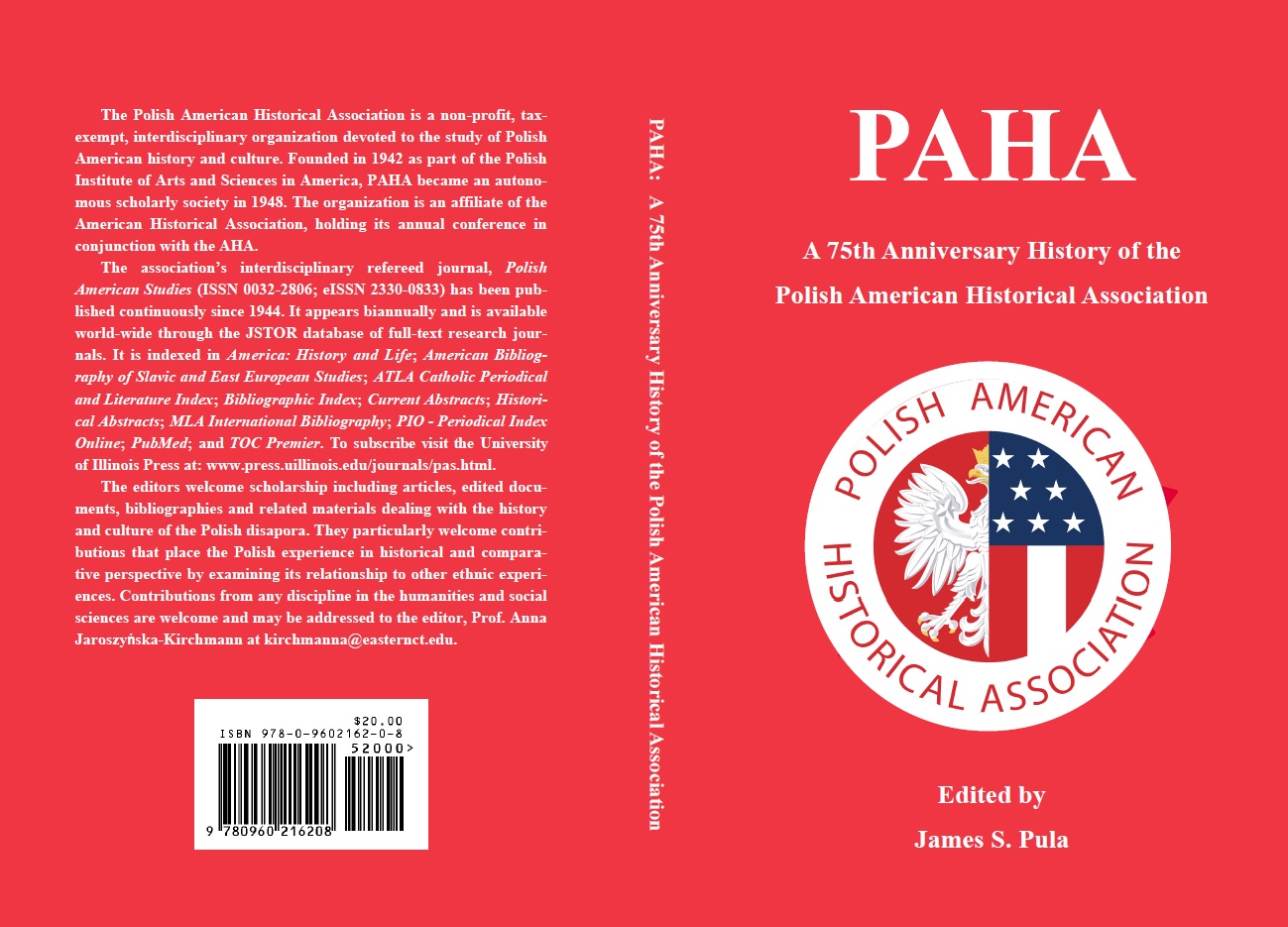
To find out more about PAHA's history and achievements, please have a look at our Anniverary Book, edited by James S. Pula and available here [click]. 

Friday, July 20, 2018

Piast Institute Founder and PAHA Member Thaddeus Radzilowski Died on July 20, 2018

Thaddeus Radzilowski, photo from Wikipedia

We are sad to report that the founder of the Piast Institute and noted scholar, Dr. Thaddeus Radzilowski, died on July 20, 2018.  It is a great loss to the entire Polish American community.

In the words of Prof. Dominic Pacyga, PAHA Board member, "Ted was a fine historian who documented what he called the Detroit School of Polonia Studies which focused on the Polish American working class. He was a friend and colleague who will be greatly missed. A true leader both in the academic and fraternal worlds, Ted encapsulated everything good in Polonia. Będę za tobą tęsknić, mój bracie."

Prof. Mieczyslaw B.B. Biskupski, President of the Polish Institute of Arts and Sciences, past President of the Polish American Historical Association, and PAHA Board member, stated: "Ted was a good friend for many years who combined insight and imagination with delightful cleverness. I had dinner with him just a few weeks ago in Miami, and, on the basis of one of his remarks, I re-wrote the last chapter of a book I have just finished. It is a grace that I mentioned him in the text. During the many dear, fun meetings we had after business was done, it was Ted who provided the laughter and the energy. I miss him so much that this is hard to write. Seeing him so recently was a gift from God to me. I ask all of you to believe that Heaven is now a better place because our beloved Ted awaits us."


The Piast Institute posted the following information about Dr. Radzilowski's passing:

PIAST INSTITUTE MOURNS THE PASSING OF DR. THADDEUS RADZILOWSKI

Today, Piast Institute, our Polish-American family, and our Hamtramck community lost a great leader in the passing of Dr. Thaddeus C. Radzilowski. Earlier today he passed away surrounded by loved ones.

Dr. Radzilowski was a highly accomplished historian and academic studying Poland and Central and Eastern Europe, producing countless manuscripts on these important topics. Over the course of his rich academic career he has taught at University of Michigan, Madonna University, Heidelberg College, and Southwest Minnesota State University. He also served as the President of St. Mary College. Over the years, he not only educated thousands of American students about Polish and Central European history, he also mentored many of them and fostered countless community leaders.

In 2003, Dr. Radzilowski co-founded the Piast Institute with Virginia Skrzyniarz. It quickly became the largest Polish-American think tank in the United States. As President of Piast, Dr. Radzilowski has focused the organization as a major research center, one of U.S. Census Information Centers, and as a representative of Poland and Polish-Americans in the United States, with worldwide network of accomplished fellows. Under his leadership, the Institute produced position papers, school curricula, research reports, conducted surveys, organized conferences and exhibits, and was very involved in the life of American Polonia. He also cultivated many relationships with Polish universities and institutions.

Over the years, Dr. Radzilowski received many awards for his academic work, community involvement, and leadership. He was a corresponding member of the Polish Academy of Sciences (PAN). He served as an advisor and consultant to the U.S. Commission on Civil Rights and the U.S. Bureau of the Census and was a member of the Ford Foundation Commission on Ethnicity in American Life. In 1999, the President of Poland presented Dr. Radzilowski with the Cavaliers Cross of the Polish Order of Merit for distinguished contributions to the dissemination of Polish culture in the world.

In addition to his contributions to preserving Polish heritage in the U.S., Dr. Radzilowski was an American patriot, a veteran of the U.S. Armed Forces who served his country in Vietnam. Those who knew Dr. Radzilowski well will miss him for his charm, his sense of humor, his countless stories, his sharp mind, and his infectious cheerfulness.

Dr. Radzilowski is survived by his wife, Kathleen, three sons, John, Paul and Stefan, grandchildren Radek and Diana, sisters Fran and Cynthia, and brothers, Norbert and Fred.

Details on a celebration of Dr. Thaddeus Radzilowski’s life will be announced shortly. Please direct any questions to the Executive Vice President of the Piast Institute Virginia Skrzyniarz, Skrzyniarz@piastinstitute.org or (313) 733-4535.


Tuesday, July 10, 2018

Call for Nominations for PAHA Awards and Prizes for 2018


Nominations are sought for the following awards that will be presented by PAHA at its 2019 Annual Meeting, in January 2019 in Chicago, Illinois. Kindly send all nominations to the chair of the awards committee, Dr.Iwona Drag-Korga (Pilsudski Institute) at i.korga@pilsudski.org.

The following award nominations must be received by July 30, 2018.

Mieczyslaw Haiman Award is offered annually to an American scholar for sustained contribution to the study of Polish Americans.

Oskar Halecki Prize recognizes an important book or monograph on the Polish experience in the United States. Eligibility is limited to works of historical and/or cultural interest, including those in the social sciences or humanities, published in the two years prior to the year of the award.

Skalny Civic Achievement Award honors individuals or groups who advance PAHA's goals of promoting research and awareness of the Polish-American experience and/or have made significant contributions to Polish or Polish-American community and culture.

Amicus Poloniae Award recognizes significant contributions enhancing knowledge of Polish and Polish-American heritage by individuals not belonging to the Polish-American community.

James Pula Distinguished Service Award is given occasionally to a member of PAHA who has rendered valuable and sustained service to the organization. Since 2017, this award honors Prof. James Pula, PAHA's past president, current treasurer, and a long-time editor of the Polish American Studies.


Saturday, June 30, 2018

Anna Muller on Teaching Polish and Polish American History in the US

 A moja babcia mówiła….  Teaching Polish and Polish-American history at an American University 

Anna Jaroszynska Kirchmann and Anna Muller, Washington, D.C.

On January 4th 2018, we gathered in an elegant room at the Omni Shoreham Hotel in Washington, DC, to listen to four Polish historians share with us their thoughts on what it means to teach Polish and Polish American history. This was the first day of the annual Polish American Historical Association convention that meet during the American Historical Association convention.

The group of historians gathered around the table included a range of specialists.  Patrice M. Dabrowski is the author of a book on the history of Poland entitled Poland: The First Thousand Years, which was referred to often by the other panelists.  Elizabeth Morrow Clark is a specialist on Polish-German relations and author of a monograph soon to be published on the free city of Danzig. Nathaniel D. Wood is a cultural historian and author of a monograph on Kraków entitled  Becoming Metropolitan; his recent research investigates the attitudes toward bicycles, automobiles, and airplanes from their introduction until WWII. The final speaker was Michał Wilczewski, a recently anointed doctor of history who examines the daily life of farmers during the interwar period, focusing on local rural activism, transformations in traditional gender roles, generational tensions and family life, and rural-state relations.

Main gate of the University of Warsaw, Poland.


Why Poland?

The panelists talked about the profile of their students, shared anecdotes from their classes, and reflected on the value of teaching Polish history in 21st century American academia.
In general, their experiences come either from teaching specifically Polish history courses or from integrating elements of Polish history into their European or world history courses. As it became very clear during the presentations and ensuing conversations, Polish history can serve to illuminate many different issues from the past and present.

Polish history certainly serves as a case study for various “-isms” in history courses (Romanticism, communism, et al). It provides a good framework for teaching about the “transition of identity and belonging from an Enlightenment understanding to the Romantic, ethnic ideal” (Clark).  It also can be used to emphasize that “nation” and “state” are not always synonymous. As Dabrowski stressed: “This [last point] is more evident than most in a Polish history course, given the long stretch of multiethnic coexistence within the various permutations that we label Polish (although we should be careful about appropriating that which was the history of more than just Poles).”

Decorative Easter Eggs from Poland.

Clark singled out specific aspects of Polish history that can be integrated into courses dealing only tangentially with the Polish past:

The very characteristics of Polish history and culture which have made it easy to mythologize and to justify particularism  -- elected kings, liberum veto, the Commonwealth, the Constitution of May 3, ethnic diversity, being the object of imperialism, a perpetual “underdog” status in the modern era, and a kind of scrappy patriotism that occasionally blossoms into resistance, revolution or rampant Messianic and virulent nationalism – those same characteristics make Poland an easy go-to in a world history classroom.

Is Poland a good case study for teaching globalization and trans-border studies? As some of the panelists emphasized, Brian Porter-Szücs (the author of Beyond Martyrdom) has definitely influenced their willingness to break out of nation-driven models in studying Poland. The history of Poland can help engage in conversations about postcolonialism or about European modernization. Our panelists also teach courses on regions and cities, borderlands and peripheries, as well as historical memory that have a Polish component.

Finally, by studying Polish history, students can learn a lot about a sense of obligation toward the state and, perhaps more than anything else, towards fellow citizens. The example of World War II serves well in this regard.  Some of the participants of the panel emphasized that, while they do talk about the unique creation of the Polish underground state during the Second World War, they do not refrain from assigning controversial readings and discussing the sense of responsibility of Poles for crimes committed during the war. Discussions of  Jan Błoński's essay on Poles as bystanders and Jan Gross’ book Neighbors have proven fruitful.

.Wooden plate with Poland's emblem and a prayer for daily bread 
brought from Poland to the US in the 1920s. Private Collection.

Polish-American history did not come up often in the discussions, although references to classes being taught on the Polish diaspora appeared frequently. At times, academics engage with issues of Polish migration that is part of a larger conversation about nationalism.

As the speakers emphasized, each group of students presents its own challenges. Wilczewski, who has taught courses in Chicago, stated: “In my thousand-year survey of Polish history which is typically capped at 60 students, I almost always have 50/60 students who are of Polish heritage and 10 others who do not identify with Poland in any way. My students are similar to me in that we are Polish-Americans, heritage speakers of Polish, some of whom attended Polish School on Saturdays and grew up going to Poland to visit family members.” He stressed that his students always think: “Hey, I know Polish history,” and that kind of approach to learning comes with its own challenges. He continued: “I once even had a student's mother read all of the readings along with us. I also once had a friend's mother remind me that I ‘need to teach good Polish history.’. My response to her was, ‘Is there bad Polish history?’”

One of the obstacle to make Polish history available is the access to various primary sources. 

Not every topic from the vast Polish history is available to students who do not read Polish language. The base of translated primary resources is narrow and/or not readily available. Hopefully the knowledge that the PAHA members gathered during the panel will motivate some of us as an organization to look for ways to make that history more available.     

                                                             ~ Anna Muller, University of Michigan, Dearborn

Stalin's stamp on Warsaw - Palace of Culture built in 1951-55.

              Select Resources For Teaching Polish History      

Textbooks:
 Patrice Dabrowski, Poland: The First Thousand Years (DeKalb: Northern Illinois University Press, 2014).
  Brian Porter, Beyond Martyrdom: Poland in the Modern World (Wiley-Blackwell, 2014).

Select primary sources available online:

selections from Anonymous Gaul, accessible at http://staropolska.pl/ang/middleages/Sec_prose/Gall.php3

 Jan Długosz, selections of his Annals, accessible at http://staropolska.pl/ang/middleages/Sec_prose/Dlugosz.php3

 Marcin Kromer, Polonia, accessible at http://staropolska.pl/ang/renaissance/Kromer/polonia.php3

  Mikołaj Rey, Life of an Honest Man, accessible at http://staropolska.pl/ang/renaissance/M_Rej/life.php3

  Andrzej Frycz Modrzewski, On the Reform of the Commonwealth, accessible at http://staropolska.pl/ang/renaissance/frycz.php3

  Piotr Skarga, Sermons to the Diet (Eighth Sermon), accessible at http://staropolska.pl/ang/renaissance/skarga.php3

  The Treaty of Brest, 1595, available at http://www.fordham.edu/halsall/mod/1595brest.html
  Jan Słomka, The Life of a Polish Peasant, ca. 1900, accessible at http://www.fordham.edu/halsall/mod/1900polishpeasant.html

  Woodrow Wilson, Fourteen Points speech, accessible at http://wwi.lib.byu.edu/index.php/President_Wilson%27s_Fourteen_Points

  American Jewish Relief Committee, report on Postwar Poland, 1919, accessible at http://hdl.handle.net/1813/2136

Report on Young Women Workers in Poland, 1952, accessible at http://hdl.handle.net/1813/2143
  J. Musiałkowski’s article on Warsaw women masons, 1949, accessible at http://hdl.handle.net/1813/2144

                                                                                                                                                                        NOTE: Reprinted from PAHA Newsletter, Spring 2018.  All Photos by Maja Trochimczyk

Thursday, May 31, 2018

75th Anniversary Conference of PAHA at Loyola University Chicago, September 7-9, 2018


75th Anniversary Conference
of the Polish American Historical Association
7-9 September 2018, Loyola University Chicago
1032 W. Sheridan Rd., Chicago, Il 60660 

Conference Hotel: Hampton Inn, North Loyola Station, 
1209 W. Albion Ave., Chicago, Il 60626

The conference is free but registration is required for all events. polishamericanstudies.org/files/public/Registration75YearsPAHA.pdf


PROGRAM

FRIDAY, SEPTEMBER 7, 2018

9:00 AM GREETINGS.  Welcome by Loyola University Chicago; Consul General of the Republic of Poland; Welcome by PAHA President

9:40 – 10:15 AM KEYNOTE ADDRESS: John Bukowczyk, PAHA within the field of US Ethnic History - past, present and future

10:30 AM –12:30 PM QUO VADIS POLISH AMERICAN STUDIES: 
THE PAHA JOURNAL AS A REFLECTION OF THE SCHOLARLY FIELD. 
Chair: Anna Jaroszyńska- Kirchmann
- A Brief History of PAS – James S. Pula 
- Labor and Working Class – Dominic Pacyga
- Polonia’s Organizations – Donald Pienkos
- Gender and Family – Mary Patrice Erdmans
- Literature – Grażyna Kozaczka
- Study of American Polonia and Scholars in Poland – Adam Walaszek

12:30 PM –  1:50 PM   LUNCH BREAK

2:00 PM – 3:20 PM  YOUNG SCHOLARS FORUM. Dorota Praszałowicz, Chair

3:30 PM – 4:50 PM PAHA’S NEW PROJECTS IN PARTNERSHIP WITH THE POLISH AMERICAN COMMUNITY. Neal Pease, Chair
- PAHA’s communication media, challenges and opportunities of the digital age – Maja Trochimczyk and Stephen Leahy
- Adjusting to the New Reality: Good Management Practices in Academia – Pien Versteegh
- PAHA and Polish American Community – Joint Projects: Polish American Travel Guide; Memoirs Project; Objects that Speak; Teaching Resources – panel discussion (Anna Jaroszynska-Kirchmann, Ewa Barczyk, Anna Muller, and Anna Mazurkiewicz)

6:00 PM BANQUET AT THE POLISH CONSULATE, CHICAGO


SATURDAY, SEPTEMBER 8, 2018

9:00 AM -11:00 AM POLISH AMERICAN HISTORY IN MUSEUMS
Dominic A. Pacyga, Chair; Anna Muller, Discussant

- Polish Museum in Chicago –Małgorzata Kot
- Muzeum Historii Polski w Warszawie – Anna Piekarska
- Chicago History Museum – John Russick
- Muzeum Emigracji, Gdynia – Sebastian Tyrakowski
- J. Piłsudski Institute – Iwona Korga

11:15 AM – 12:45 PM  CONCURRENT EVENTS
a) LOYOLA ARCHIVE TOUR with Nancy Freeman
b) FILM SCREENING (TBA)

1:00 PM – 2:00 PM  LUNCH BREAK

2:00 PM – 3:00 PM  PAHA 2018 HALECKI BOOK PRIZE 
Joanna Wojdon, White and Red Umbrella – Presentation of the Haiman Medal and Discussion of the Prize-winning Book 

3:00 PM – 5:00 PM  POLONIA ROUNDTABLE: Advancement and Promotion of Polish and Polish American Studies in the United States. Chair: Bożena Nowicka McLees. Discussants:  Members of Chicago/Great Lakes Polish-American social and cultural organizations. 

5:30 PM.  RECEPTION FOR PARTICIPANTS 

8:00 PM.  CONCERT 


SUNDAY, SEPTEMBER 9, 2018

MORNING EVENTS:

A) PAHA BOARD MEETING: 8:30 AM – 12:30 PM and Working Lunch to 1:30 PM
B) BUS TOUR FOR REGISTERED GUESTS: 9:30 AM -13:00 PM  
Tour of North Side of Chicago with Victoria Granacki 

AFTERNOON BUS TOUR (for PAHA Board members only): 1:30 PM – 4:30 PM Bus Tour of South Side of Chicago with Dominik Pacyga


ORGANIZERS

Conference organizers include the following institutions in Poland and the U.S.: 
  • Polish American Historical Association, 
  • Polish Studies Program at Loyola University Chicago; 
  • Polska Akademia Umiejetnosci; 
  • Wydział Studiów Międzynarodowych i Politycznych Uniwersytetu Jagiellońskiego: 
  • Instytut Amerykanistyki i Studiów Polonijnych, 
  • Jagiellońskie Centrum Studiów Migracyjnych; and 
  • Komitet Badań nad Migracjami Polskiej Akademii Nauk 

FUNDED IN PART by the Senate of the Republic of Poland.

PROGRAM COMMITTEE: 
  • Prof. Anna Mazurkiewicz – President on behalf of PAHA
  • Prof. Zygmunt Kolenda – President on behalf of PAU 
  • Bozena Nowicka McLees – Loyola University 
  • Prof. Dominic Pacyga – PAHA/ Columbia College Chicago 
  • Prof. Dorota Praszałowicz – PAN/PAHA 
  • Prof. James Pula – PAHA/PurdueUniversity 
  • Prof. Adam Walaszek – Jagiellonian University/PAHA 


Tuesday, May 15, 2018

Anna Jaroszynska Kirchmann about Polish American Studies 75/1


In the year when Polish American Historical Association celebrates 75 years of its work, it is highly satisfying to see how our journal Polish American Studies reflects the development of our scholarly field. The Spring 2018 issue of PAS (Vol. 75, no. 1) features on the cover a photograph taken during the very first meeting of what became PAHA in New York in 1943. Although to the contemporary observer it is now striking that the group does not include any women, the first issue of PAS did feature an article by Rev. Sister M. Ligouri, Ph.D., from St. Mary's High School in Worcester, Mass. If you are interested in the history of those early years of PAHA and PAS, pick up the recently published book, edited by James S. Pula, which discusses various directions and areas of development of our organization over the last 75 years.

The Spring 2018 issue of PAS brings together three articles, posing questions about Polish American experience seen in three different and little known contexts. James S. Pula examines antislavery arguments promoted by the early immigrants from the Polish lands to America. Thomas Hollowak describes various aspects of the unique experience of Polish immigrants who found employment in oyster dredging in the Chesapeake Bay. Kathleen Urbanic and Thomas Duszak present a history of Polish Baptists in the United States, as seen through the activities of the parishes in Rochester, NY, and Wilmington, DE.

The issue features also books by Anna Rudek-Smiechowska, Sylvie Aprive, Rachel Feldhay Brenner, Joshua Blank, Tara Zahra, Czeslaw Karkowski, and Marek Liszka.

Subscription to PAS comes as part of the membership in PAHA. To join, visit the website of University of Illinois Press, the publisher of our journal.

To find out more about the journal, about its editorial board, and submissions, visit PAS page on PAHA Website: http://polishamericanstudies.org/text/13/polish-american-studies.html. The website also features tables of contents of earlier issues of PAS. These articles are available as PDF downloads from JSTOR.


Monday, April 23, 2018

Interview with Professor James S. Pula by Aleksandra Ziółkowska-Boehm


Interview with Professor James S. Pula of Purdue University - 
Historian, Professor, Author, and Polonia Activist
by Aleksandra Ziółkowska-Boehm
1
Aleksandra Ziółkowska-Boehm: You grew up in a small village, New York Mills, in central New York State where 75percent people were of Polish heritage. Both your father’s parents came to America from Poland. Your father born in America but spoke Polish. On your mother side you are French origin. Since you mother did not speak Polish and your father did not understand French, the language was used home was English. Do you have a little knowledge of French and Polish?

James S. Pula: Since so many people in our village knew Polish, it was never offered as a language until after I had already graduated from high school, and it was not offered at any of the colleges I attended. In graduate school I studied French to pass a reading test for research purposes since that was a requirement of my PhD in history. However, I have rarely used it since then so I have lost most of my facility with it.

2
Ziółkowska-Boehm: You are the author of many books, specializing in ethnic and immigration studies and 19th-century American history. Your first book titled “The French in America” (1975) was published in series on American ethnic group. What is the unique about French Americans?

Prof. Pula: There were small communities of French in Philadelphia (PA), Charleston (SC), and of course New Orleans (LA) since colonial times. French influence in Louisiana remains strong even today. Unlike all of the other states, its basic legal code derives from the French Code Napoleon. My mother’s ancestors came down from Québec to work in the logging camps in the Adirondack Mountains in New York. Quite a few people of French ancestry were prominent in the Revolutionary War and early American history, but I think the most unique feature of the French is how quickly they appear to have assimilated into American society regardless of when they arrived.

Prof. Pula with PAHA President, Anna Mazurkiewicz, 2015.

3
Ziółkowska-Boehm: You write that you remember from childhood years there were differences between Poles coming from “Austria” and “Russia” during the time of the partitions when Poland lost its independence. At that time Polish immigrants coming to America were registered as from Austria, Germany, or Russia. You write that you also remember that in your village the Poles were divided between those attending the Roman Catholic Church and those who attended the Polish National Catholic Church (Kosciol Narodowy). How much were those differences visible in everyday lives?

Prof. Pula: There were differences of association. Since many of the organizations in town were either based in the parishes, or loosely affiliated with them, membership in these was dictated by whether one was Roman Catholic or National Catholic. The groups even had different cemeteries. The two did not mix, except in the Polish National Alliance and in the local textile union which were open to people regardless of religious affiliation. So as adults social activities were often a dividing factor. For children it was much the same. Most Polish children, like my father, went to the Roman Catholic parochial school until they graduated and then had to attend the public school beginning in eighth grade. National Catholic children could not attend the Roman Catholic school so some attended National Catholic schools in nearby Utica while others went directly into the public schools at an early age. Naturally these divisions meant that children were often not able to take part in each other’s social activities. Once in high school, these divisions largely ended when it came to attending school-related activities, but persisted for anything sponsored by the parishes.

4
Ziółkowska-Boehm: As a student you were fascinated with the subject of the American Revolution. You graduated from SUNY –Albany, and your interest build up. Your second book was dedicated to General Włodzimierz Bonawentura Krzyżanowski who took part in the Civil War. He was eulogized by president Franklin D. Roosevelt in 1937 at Arlington. His life was so interesting I believe he deserves a movie. Tell us more about the hero of your book For Liberty and Justice: The Life and Times of Wladimir Krzyzanowski.

Prof. Pula: He was indeed a very fascinating figure. He came from a poor gentry family and was involved in the planning for the Mierosławski uprising in 1846. The Prussians placed him on trial but he escaped before being captured and came to the US. He apparently worked as an engineer for a while, then married an American woman named Caroline Burnett and opened a pottery business in Washington, DC. When the Civil War broke out he volunteered in the local militia as a private and quickly rose to captain. After receiving permission to recruit his own regiment, he was promoted to colonel of the 58th New York, which later adopted the nickname “Polish Legion.” Krzyżanowski fought in many of the largest battles of the war at Cross Keys, Second Bull Run, Chancellorsville, Gettysburg, and Chattanooga. In all of these he gained praise from his commanders, eventually earning promotion to brigadier general.

Following the war he was a successful agent for the US Treasury Department where he was responsible for tracking down smugglers in Louisiana and later the Washington Territory, Alaska, and Panama. When he moved to San Francisco he met Helena Modjeska when she came to America and was instrumental in scheduling her debut in California. He also knew Henryk Sienkiewicz who frequented the tavern Krzyżanowski owned. It was there that Sienkiewicz observed some of the personality traits of the patrons that he later used in his writings.

Quite a career for someone forced to leave his homeland for a new country whose language he did not even know. In 1937 his remains were reburied in Arlington National Cemetery.

Prof. Pula at the gates to the University of Warsaw, Poland.

5
Ziółkowska-Boehm: After graduation you taught for two years in South Carolina at a mostly black college. Later you moved to the University of Maryland and you were sent overseas to participate in their programs in Japan, Korea, Germany, and Italy. You experienced a lot of multi-ethnic human diversity with different origin people. Please tell more about it.

Prof. Pula: Teaching overseas was a life-changing experience in so many ways. Living in other cultures, especially in places like Japan and Korea with very different historical and cultural traditions, makes one much more aware of what immigrants face when they arrive in a new country. For someone teaching immigration history, this was an invaluable experience.

One also learns that there are “good” and “bad” people everywhere and that just because something is different does not mean it is less valuable. I think no matter where we come from we all tend unconsciously to judge things by the norms and values of the society in which we grew up. Living in all of these different countries gives one a different perspective. Cultures and ways of doing things may be different, but there is not necessarily any hierarchy — what is accepted and works within a given society is just as valid as what works and is accepted in another society.

And the human variety is amazing. All of the different foods, music, religions, art, and so much else. Spending time in these different cultures was the best education I could ever have hoped to obtain, and a lot more interesting than sitting in a classroom.


Ziółkowska-Boehm: You stated in Polish American Studies (Autumn, 2017) that your early life experiences led you to: “professional lines of research and teaching” that also “have taught you the most valuable of all lessons, that people in all groups are much more alike than they are different…. People, both the ‘good’ and the ‘bad,’ are largely the same everywhere.” What can you add to this beautiful statement?

Prof. Pula: Only that it is unfortunate that individual people cannot be viewed and accepted for what they are — individuals. We always want to place labels on people, to put them into groups, when in fact everyone is unique with individual strengths and weaknesses and should be seen as an individual. If we judged each other by, as Martin Luther King said, the “content of their character,” instead of trying to place them in groups or categories the world would be a better place.

Prof. Pula at PAHA's 75th Annual Meeting in Washington D.C. January 2018

7
Ziółkowska-Boehm: Publishing papers, articles, books chapters - you presented your own experience on comparative work - on Germans, Italians, Hispanics, Asian, and others group. It is very interesting and mind-opening reading about diversities and perceptions of different ethnic group in the USA. If asked, I believe, all of the groups would have their - more or less - “songs of complains.”

Prof. Pula: That is an interesting observation. Every group that has come in large numbers to the US has left its own country for specific reasons, and often these reasons are essentially the same for many groups — political or religious persecution, lack of economic opportunity, famine or other natural disaster, and so on. When they arrive in the United States, if there are large numbers they draw attention and sometimes a negative reaction from people already there. The Irish and German immigrants faced a backlash against them in between 1830 and 1860; Poles, Italians, and Jews were often discriminated against in 1880-1920; Asians met opposition in 1880-1900; and more recently Mexican and other Hispanic immigrants have faced the same problems. One of the things one learns is that for each large wave of people, the experience is much the same. If the group is large enough to be perceived as a threat by those already in the US (that is, a competition), especially if there is an economic recession, the group is perceived as a “problem.” In the second and third generations they begin to assimilate and some other group takes their place as the unfamiliar newcomers.

A good example is a pair of editorials I ran across while doing research a couple of decades ago. In the 1830s a newspaper in St. Louis complained in an editorial that the city was being overrun with Irish immigrants who were uneducated, had different customs, and were on top of all that Catholic! Twenty years later the exact same newspaper ran a similar editorial bemoaning the fact that so many German immigrants were arriving and they has strange customs like having picnics on Sunday where they drank beer, spoke in a different language, and kept too much to themselves. The editorial ended with the sentence “Where have all the noble Irish gone?” All of a sudden the Irish were now “noble.” What happened to elevate them? A combination of assimilation and familiarity. So fear of the newcomer was transferred to a newer group, the Germans. It is a process that continually changes only in the names of the groups that are involved.

Cover of the Polish American Encyclopedia edited by Prof. Pula

8
Ziółkowska-Boehm: You were giving courses at the university in ethnic and immigration studies, also about U.S. immigrations policy. I value your interest in the Polish presence in America – before the Great Migration. Quite a few of your books are dedicated to Polish American ethnic subjects, like United We Stand: The Role of Organized Labor in a Polish American Community, 1910-1916 (1990). In your book Ethnic Utica (1994) you present the mosaic of American society. Twelve essays are dedicated to Welsh, Irish, Polish, German, Italian, Syrian/Lebanese, Jewish, African-American, Ukrainian, Oneida Indian, Bosnians. Do you write about immigrants from South America?

Prof. Pula: The book on Polish labor strikes was particularly enjoyable to write since it focused on the town in which I grew up. It is an amazing story of a group of Polish factory workers who organized in the face of opposition from a major textile company and overcame all adversity to win their strikes. They later took these organizational skills into the political arena to literally take over the village government by electing a mayor and a majority of the village board.

Ethnic Utica was a book I edited so the chapters were written by several different authors. The topics were selected by looking at the census for the area and selecting the largest of the groups in the county. Since then Hispanic immigration has increased and the same people that published my book just published one on the Hispanic community as well. Aside from Ethnic Utica, I have written articles on Hispanics for encyclopedias and recently published an article titled “Is the New Immigration Really New? A Comparison of 1910 and 2010” in which I compare the demographic and assimilation of Poles and Italians in the US in 1910 with Mexicans in 2010. It was published in Agnieszka Małek and Dorota Praszałowicz, eds., The United States Immigration Policy and Immigrants’ Responses: Past and Present (Frankfurt am Main: Peter Lang, 2017). Actually, the data suggest that Mexican immigrants are progressing toward assimilation faster today than were Poles and Italians a century ago.

9
Ziółkowska-Boehm: You earned both a M.A. and Ph.D. from Purdue University with a major in American history. As part of your interest you wrote a book dedicated to Kosciuszko: Thaddeus Kościuszko: The Purest Son of Liberty (1998). Is Kosciuszko your favorite Polish origin hero? What is the subject you are working on now?

Prof. Pula: Yes, I have admired Kościuszko for some time, actually since I first became aware of him in high school. He really made important contributions to the American Revolution at Saratoga where his engineering skills helped to win a battle that brought the French and Spanish into the war on the side of the rebellious colonials. He went on to build the first fortification at West Point where the US Military Academic is today, to serve with distinction in the Carolinas, and then to return to Poland to lead an unsuccessful revolution to free his own nation. More importantly, as I learned more about him I have been exceptionally impressed by his humanity. In America he befriended the poor, slaves, and indigenous peoples. In Poland he emancipated the peasants on his own land and during the Kościuszko Uprising he proposed citizenship rights for peasants, Jews, and others. His continual support for the less fortunate classes of people is truly commendable. Thomas Jefferson once wrote that the Pole was the “purest son of liberty” he ever met, and of that liberty that went to everyone, not just the rich and powerful.

Right now I am finishing a two-volume publication on the American Civil War that focuses on German immigrants and, to a lesser extent, other immigrants from central and Eastern Europe who fought in the Civil War. I am also editing a 75th anniversary history of the Polish American Historical Association which should be finished next month.

PAHA's Anniversary History at the 75th Annual Meeting in Washington, D.C.

10
Ziółkowska-Boehm: You wrote numerous essays, lectures, papers, and book reviews on Polish subjects. Quite a few of your books are dedicated to Polish American subjects. Together with historian Professor M.B. Biskupski you have published essays and documents titled Polish Democratic Thought from the Renaissance to the Great Emigration: Essays and Documents (1990). Please, tell us about that volume.

Prof. Pula: In that book we brought together a group of prominent historians to write essays on the development of democratic thought in Poland during various eras and supplemented this with the publication of English translations of important documents to make them available to English-speaking scholars. We followed it up with a second volume that begins where the first one left off and continues on through the eventual regaining of Polish independence from Soviet influence. The title of the second volume is The Origins of Modern Polish Democracy (Athens, OH: Ohio University Press, 2010).

11
Ziółkowska-Boehm: You are also very active in the Polish American intellectual community. You were president of The Polish American Historical Association (PAHA), editor of Polish American Studies for 33 years, associate editor of The Polish Review, and an active member of the Board of The Polish Institute of Arts and Sciences in America (PIASA). Among others awards you received the Amicus Poloniae Award, the Mieczysław Haiman Award, and the Krzyż Oficerski Orderu Zasługi Rzeczypospolitej Polskiej [Officer’s Cross of the Order of Merit of the Republic of Poland]. You are a great treasure for Polish culture and history. What do you think can be done for better understanding of the Polish Americans?

Prof. Pula: There is, fortunately, a great wealth of scholarship in both English and Polish on a broad range of Polish American topics. Today, more comparative studies are appearing which is also positive. I think the main problem is integrating these scholarly studies into the mainstream of academic publishing. Both Polish American Studies and The Polish Review are now members of JSTOR, a full-text academic database that makes them available to scholars at more than 6,000 libraries, archives, and other organizations around the world. This is a tremendous advance in placing these materials before scholars writing textbooks, comparative studies, and other publications that will reach a very broad audience. It would be very helpful if some of the Polish journals such as Studia Migracyjne-Przegląd Polonijny could also be made available this way because they contain some excellent studies that would benefit from a wider audience.

Another thing we can do, as academics, is to focus more of our attention on the general public. We often spend all of our time talking to each other in very stimulating conferences, but the results of these are shared in written form in academic journals and seldom if ever reach the general public. This is good for us as individual academics as we build a portfolio for tenure and promotion, but it has no influence on public perceptions. We need to spend more time giving public lectures, working with local community education projects and teachers, and reaching out to deliver our message about the history and culture of Poles and Polish Americans to newspapers, community groups, and other public forums.


NOTE: This interview was conducted in English in November 2017 and published in Polish translation in the journal Odra, April 2018.